
Geothermal energy has huge potential to generate clean power — including from used oil and gas wells
Moones Alamooti, assistant professor of energy and petroleum engineering, University of North Dakota | December 01, 2025 The world’s largest geothermal power station is under construction in Utah. Source: Business Wire via AP
As energy use rises and the planet warms, you might have dreamed of an energy source that works 24/7, rain or shine, quietly powering homes, industries and even entire cities without the ups and downs of solar or wind — and with little contribution to climate change.
The promise of new engineering techniques for geothermal energy — heat from the Earth itself — has attracted rising levels of investment to this reliable, low-emission power source that can provide continuous electricity almost anywhere on the planet. That includes ways to harness geothermal energy from idle or abandoned oil and gas wells. In the first quarter of 2025, North American geothermal installations attracted US$1.7 billion in public funding — compared with $2 billion for all of 2024, which itself was a significant increase from previous years, according to an industry analysis from consulting firm Wood Mackenzie.
As an exploration geophysicist and energy engineer, I’ve studied geothermal systems’ resource potential and operational trade-offs firsthand. From the investment and technological advances I’m seeing, I believe geothermal energy is poised to become a significant contributor to the energy mix in the U.S. and around the world, especially when integrated with other renewable sources.
A May 2025 assessment by the U.S. Geological Survey found that geothermal sources just in the Great Basin, a region that encompasses Nevada and parts of neighboring states, have the potential to meet as much as 10% of the electricity demand of the whole nation — and even more as technology to harness geothermal energy advances. And the International Energy Agency estimates that by 2050, geothermal energy could provide as much as 15% of the world’s electricity needs.
Why geothermal energy is unique
Geothermal energy taps into heat beneath the Earth’s surface to generate electricity or provide direct heating. Unlike solar or wind, it never stops. It runs around the clock, providing consistent, reliable power with closed-loop water systems and few emissions.
Geothermal is capable of providing significant quantities of energy. For instance, Fervo Energy’s Cape Station project in Utah is reportedly on track to deliver 100 megawatts of baseload, carbon-free geothermal power by 2026. That’s less than the amount of power generated by the average coal plant in the U.S., but more than the average natural gas plant produces.
And geothermal energy is becoming economically competitive. By 2035, according to the International Energy Agency, technical advances could mean energy from enhanced geothermal systems could cost as little as $50 per megawatt-hour, a price competitive with other renewable sources.
Types of geothermal energy
There are several ways to get energy from deep within the Earth.
Hydrothermal systems tap into underground hot water and steam to generate electricity. These resources are concentrated in geologically active areas where heat, water and permeable rock naturally coincide. In the U.S., that’s generally California, Nevada and Utah. Internationally, most hydrothermal energy is in Iceland and the Philippines.
Some hydrothermal facilities, such as Larderello in Italy, have operated for over a century, proving the technology’s long-term viability. Others in New Zealand and the U.S. have been running since the late 1950s and early 1960s.
 A drilling rig sits outside a home in White Plains, New York, where a geothermal heat pump is being installed. Source: AP/Julia Nikhinson
Enhanced geothermal systems effectively create electricity-generating hydrothermal processes just about anywhere on the planet. In places where there is not enough water in the ground or where the rock is too dense to move heat naturally, these installations drill deep holes and inject fluid into the hot rocks, creating new fractures and opening existing ones, much like hydraulic fracturing for oil and gas production.
A system like this uses more than one well. In one, it pumps cold water down, which collects heat from the rocks and then is pumped back up through another well, where the heat drives turbines. In recent years, academic and corporate research has dramatically improved drilling speed and lowered costs.
Ground source heat pumps do not require drilling holes as deep, but instead take advantage of the fact that the Earth’s temperature is relatively stable just below the surface, even just 6 or 8 feet down (1.8 to 2.4 meters) — and it’s hotter hundreds of feet lower.
These systems don’t generate electricity but rather circulate fluid in underground pipes, exchanging heat with the soil, extracting warmth from the ground in winter and transferring warmth to the ground in summer. These systems are similar but more efficient than air-source heat pumps, sometimes called minisplits, which are becoming widespread across the U.S. for heating and cooling. Geothermal heat pump systems can serve individual homes, commercial buildings and even neighborhood or business developments.
Direct-use applications also don’t generate electricity but rather use the geothermal heat directly. Farmers heat greenhouses and dry crops; aquaculture facilities maintain optimal water temperatures; industrial operations use the heat to dehydrate food, cure concrete or other energy-intensive processes. Worldwide, these applications now deliver over 100,000 megawatts of thermal capacity. Some geothermal fluids contain valuable minerals; lithium concentrations in the groundwater of California’s Salton Sea region could potentially supply battery manufacturers. Federal judges are reviewing a proposal to do just that, as well as legal challenges to it.
Researchers are finding new ways to use geothermal resources, too. Some are using underground rock formations to store energy as heat when consumer demand is low and use it to produce electricity when demand rises.
Some geothermal power stations can adjust their output to meet demand, rather than running continuously at maximum capacity.
Geothermal sources are also making other renewable energy projects more effective. Pairing geothermal energy with solar and wind resources and battery storage are increasing the reliability of above-ground renewable power in Texas, among other places.
And geothermal energy can power clean hydrogen production as well as energy-intensive efforts to physically remove carbon dioxide from the atmosphere, as is happening in Iceland.
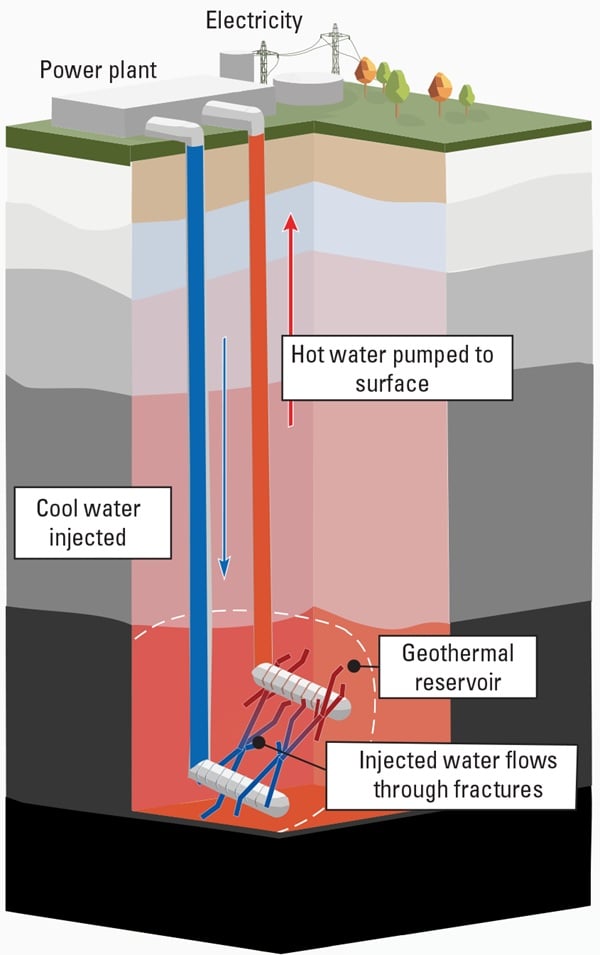 Enhanced geothermal systems can be built almost anywhere and can take advantage of existing wells to save the time and money of drilling new holes deep into the ground. Source: U.S. Geological Survey
Geothermal potential in the US and worldwide
Currently, the U.S. has about 3.9 gigawatts of installed geothermal capacity, mostly in the West. That’s about 0.4% of current U.S. energy production, but the amount of available energy is much larger, according to federal and international engineering assessments.
And converting abandoned oil and gas wells for enhanced geothermal systems could significantly increase the amount of energy available and its geographic spread.
One example is happening in Beaver County, in the southwestern part of Utah. Once a struggling rural community, it now hosts multiple geothermal plants that are being developed to both demonstrate the potential and to supply electricity to customers as far away as California.
Those projects include repurposing idle oil or gas wells, which is relatively straightforward: Engineers identify wells that reach deep, hot rock formations and circulate water or another fluid in a closed loop to capture heat to generate electricity or provide direct heating. This method does not require drilling new wells, which significantly reduces setup costs and environmental disruption and accelerates deployment.
There are as many as 4 million abandoned oil and gas wells across the U.S., some of which could shift from being fossil fuel infrastructure into opportunities for clean energy.
Challenges and trade-offs
Geothermal energy is not without technical, environmental and economic hurdles.
Drilling is expensive, and conventional systems need specific geological conditions. Enhanced systems, using hydraulic fracturing, risk causing earthquakes.
Overall emissions are low from geothermal systems, though the systems can release hydrogen sulfide, a corrosive gas that is toxic to humans and can contribute to respiratory irritation. But modern geothermal plants use abatement systems that can capture up to 99.9% of hydrogen sulfide before it enters the atmosphere.
And the systems do use water, though closed-loop systems can minimize consumption.
Building geothermal power stations does require significant investment, but its ability to deliver energy over the long term can offset many of these costs. Projects like those undertaken by Fervo Energy show that government subsidies are no longer necessary for a project to get funded, built and begin generating energy.
Despite its challenges, geothermal energy’s reliability, low emissions and scalability make it a vital complement to solar and wind — and a cornerstone of a stable, low-carbon energy future.
Editor's note: This article originally ran on The Conversation and appears here thanks to its Creative Commons license.


Mention should be made of Quaise Energy, who is trying to develop a method of deep drilling utilizing gyrotrons to enable large scale geothermal energy production anywhere
I've always liked the idea of geothermal energy, but it won't be economical everywhere.
I live in West Texas, which is an arid climate, hot and dry in the summer. I'd love to cool my house with ground water, which comes out of my water well at 60° F. To get to a temperature warm enough to heat my house in the winter would require drilling a well to a depth of about 4000 feet, which is well beyond my budget.
I would presume that in order to operate a power generation plant, you would need a temperature significantly above the boiling point of water to generate steam. In my area, that would require a depth of about 20,000 feet.
I like the idea of reusing plugged oil & gas wells, but they are typically spaced thousands of feet apart. I would think that considerable heat would be lost going this distance to a plant unless the pipelines were buried. Another problem with old wells is that the condition of the casing (pipe) is often deteriorated and the wells are normally plugged with cement. Wells are normally not cemented top to bottom, but cast iron plugs topped with cement are set at various depths in the wellbore. A geothermal well requires two strings of tubing (in and out) within the casing. Casing in a deep well typically has an ID of about 5" which means that the tubing strings will be quite small and flowrate would be very limited. In order for this to work, high temperature formations would have to be close to the surface to allow for larger pipe. As mentioned in the article, it could work in some areas.
One correction I'd make to the article: hydraulic fracturing doesn't typically cause earthquakes. Fraccing (the correct industry term) is the process of pumping thousands of gallons of water and sand into a formation quickly to cause the rock to crack. The water is then allowed to flow back to the surface slowly and the sand stays in place to hold the fractures open to allow oil to flow. Earthquakes in oil & gas regions are thought to be caused by continuous injection of waste water into relatively shallow formations.