
Enhanced geothermal systems expand power production potential
N. Mughees | October 17, 2025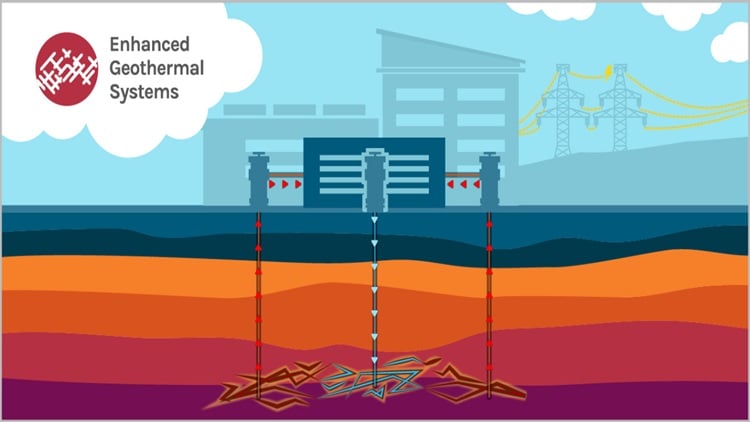 Source: U.S. Department of Energy
Enhanced geothermal systems (EGS) are an advanced form of geothermal energy technology developed to harness Earth’s internal heat in areas that lack naturally occurring hot water or steam. Traditional geothermal systems depend on the presence of underground reservoirs of water and permeable rock, typically found in volcanically active regions. In contrast, EGS can be implemented in regions where the subsurface consists of hot but dry and impermeable rock. This article will discuss this technological advancement in detail as it significantly broadens the potential application of geothermal energy, making it accessible even in geologically stable, non-volcanic areas.
Energy production mechanism in EGS
The process of energy generation in an EGS begins with drilling deep wells — often several kilometers beneath the Earth’s surface — into hot, dry rock formations. Once the appropriate depth and temperature are reached, water is injected at high pressure to artificially fracture the rock, creating a network of small cracks or fissures. This fracture network forms a reservoir that allows water to circulate and absorb heat from the surrounding rock.
As the injected water moves through these fractures, it becomes heated and is then pumped back to the surface through production wells. The hot water or steam extracted at the surface is used to drive turbines that generate electricity. After the heat is transferred, the cooled water is re-injected into the ground, completing a closed-loop cycle. This approach ensures that the resource is sustainable over long periods without significant depletion.
Difference between traditional and EGS
|
Aspect |
Traditional geothermal |
EGS |
|
Resource | Naturally occurring hot water/steam | Hot dry rock with little/no water |
|
Location | Areas with active volcanism or geothermal springs (like Iceland, New Zealand) | Anywhere with sufficient subsurface heat, even without water |
|
Reservoir | Naturally permeable and porous | Artificially fractured and engineered |
|
Development | Minimal stimulation needed | Requires hydraulic stimulation and advanced drilling |
|
Use | Mature technology, widely used | Emerging/experimental, but promising for global use |
Is EGS a renewable energy source?
Yes, it is considered as a source of renewable energy. This classification is based on the fact that the source of energy in EGS is the Earth's internal heat, which is virtually inexhaustible on a human timescale. The Earth continuously generates heat through the natural decay of radioactive isotopes in its core and mantle. This geothermal heat is constantly replenished, making it a sustainable energy source.
In EGS, water is injected into hot rock formations to extract this heat, and then it is circulated back into the ground in a closed-loop system. As long as the system is carefully managed — meaning the rate of heat extraction does not exceed the rate at which heat can flow back into the rock — the system can operate continuously for decades or even centuries.
Deployment in non-traditional areas
One of the most important advantages of EGS is its suitability for deployment in non-traditional areas — regions that do not exhibit natural geothermal activity such as hot springs, geysers or volcanic features. These areas, often referred to as geologically stable zones or continental interiors, typically lack the hydrothermal conditions needed for conventional geothermal power. However, they often still possess sufficient underground heat at great depths, which EGS can tap into using engineered systems. This opens up the possibility of producing geothermal energy in locations that were previously considered unsuitable, including much of the central U.S., China, Europe and Australia.
Advantages of EGS for energy production
· Base-load power: Unlike solar and wind, EGS can run 24/7, regardless of weather or time of day.
· Low emissions: EGS produces negligible greenhouse gases compared to fossil fuels.
· High energy density: Small land footprint with high energy output.
· Wider deployment: Can work in regions without natural geothermal activity.
· Closed-loop system: Because EGS is a closed-loop system, it minimizes water consumption and avoids contamination of surface or groundwater resources.
Real-world applications and progress
In recent years, several demonstration projects around the world have validated the potential of EGS. The U.S. Department of Energy’s FORGE (Frontier Observatory for Research in Geothermal Energy) project in Utah is a dedicated field laboratory for developing EGS technologies. Private companies such as Fervo Energy have successfully demonstrated commercial-scale EGS using advanced drilling and real-time monitoring techniques. In Australia, the Cooper Basin EGS project was one of the first to prove the viability of this approach in a non-traditional, non-volcanic region. These initiatives showcase the growing feasibility and promise of EGS as a practical energy source.
Challenges and future outlook
Despite its promise, EGS still faces several challenges. The cost of drilling deep wells and stimulating the reservoir can be high, particularly in early-stage projects. There is also concern over induced seismicity — small, human-triggered earthquakes that can occur due to hydraulic fracturing. Addressing these issues requires continued research, improved technology and regulatory oversight. However, as innovation progresses and economies of scale are achieved, it is expected that EGS will become more cost-effective and widespread. The potential for EGS to supply clean, reliable and sustainable electricity on a global scale makes it a critical component in the future of renewable energy systems.
Conclusion
EGS technology is being developed for energy production, turning Earth’s natural heat into a clean, reliable and globally accessible source of electricity — even in areas where conventional geothermal would not work. It's a key part of the future renewable energy mix. With their ability to deliver constant power, minimal environmental impact and scalability, EGS technologies are positioned to play a significant role in the transition to a cleaner and more resilient global energy system.




Geothermal heating for houses is expensive to install, unreliable and requires extensive maintenance. Many homes already have heat pumps installed and require electric heating in winter. Many homeowners, for example I, would be interested investing in EGS based power generation plants that sell their output at low cost to power companies. The power companies then offer discounts to EGS investors, proportional to their invested amounts until the investors receive a reasonable return on their investment. If the investor wants to sell their home, the lower cost electricity could be an incentive. Financial experts can make the shortcomings of this plan right. This financial system might have the potential to allow a very large number of electric power consumers to participate in renewable energy usage without the complicated, unreliable and expensive contraptions added to their houses. Just a thought to make "green energy" more feasible to occupants of our planet.
You all have a good day.
Ahmet