Hydrogen and chemicals derived from biowaste
S. Himmelstein | May 26, 2026A major impediment in hydrogen production is the oxygen evolution reaction at the anode of conventional electrolysis systems, which requires high energy input and exhibits slow kinetics, thereby reducing overall process efficiency and economic feasibility. Researchers in South Korea have sought to overcome this drawback by developing an anion exchange membrane water electrolysis system that relies on glycerol as an alternative feedstock and applies the glycerol oxidation reaction at the anode as a paired electrolysis strategy.
The technology described in Joule not only yields hydrogen but also produces formate and other value-added chemicals with glycerol, a low-cost, abundant byproduct of biodiesel production, as the process driver. The reaction proceeds at lower energy input compared to conventional water electrolysis and achieves high catalytic activity and stability by means of a low-cost copper-cobalt-based non-precious metal catalyst. The system demonstrated a high current density of 110 mA/cm² at a relatively low cell voltage of 1.31 V.
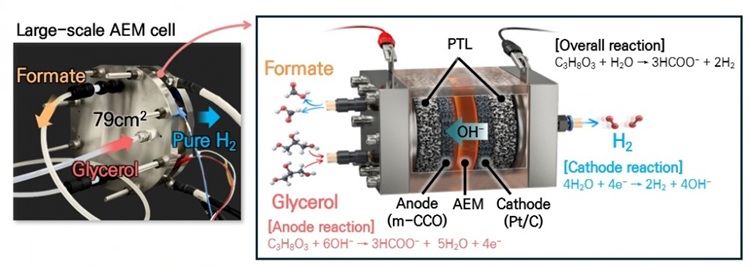 Schematic illustration of the 79 cm² large-area anion exchange membrane electrolyzer system. Source: Korea Institute of Materials Science
The system maintained a high selectivity of approximately 96% toward formate as the target chemical product, and stable performance was confirmed in a large-area electrolyzer cell of 79 cm², demonstrating its potential for practical industrial applications.
The electrochemical system was designed and tested by researchers from the Korea Institute of Materials Science, Ulsan National Institute of Science and Technology, Pusan National University, Korea Electronics Technology Institute and the University of Seoul.