The ESA has a space junk plan; will it be enough?
Andy Tomaswick | October 12, 2025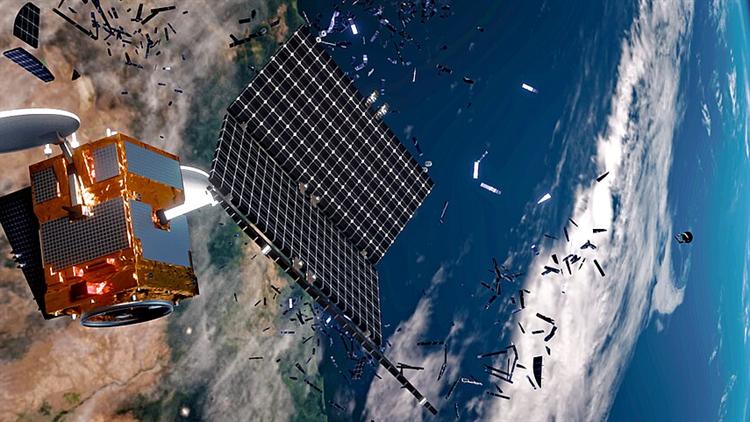 Source: ESA/ID&Sense;ONiRiXEL/CC BY-SA 3.0 IGO
Space debris is a serious hazard. There are an estimated 40,000 objects with at least a 10 cm diameter in orbit, many going as fast at 28,000 mph.
That’s fast enough that if it hit a stationary object, even such a tiny fragment would release an explosion equivalent to 27 kg of TNT.
And each time those collisions happen, they introduce new fragments into the mix, potentially causing a catastrophic cascade known as Kessler Syndrome, which was named after Donald Kessler, a NASA astrophysicist who first came up with the idea alongside Burton Cour-Palais in 1978.
The European Space Agency (ESA) hopes to avoid that fate for future spacefarers, and has created the Zero Debris Charter as program for ensuring that it doesn’t happen. But first, all major players of space exploration must agree with it.
A ground stop for space launches?
Kessler syndrome means there is so much hypervelocity debris in orbit that it would be impossible to launch craft, or even maintain existing satellites in orbit. That's a challenge on a planet with starry ambitions. Humanity would become Earth-bound until we found a way to clear up the orbital paths enough that we can once again begin launching rockets out of our gravitational well.
In the process, we would lose access to all sorts of useful technologies, from GPS navigation to weather forecasting and satellite internet. Some very fundamental technologies, whose collateral debris are behind the problem, would be lost and needed to be rebuilt.
To be clear, this critical threshold hasn't been hit yet - orbits are huge, and the distance between Starlink satellites in low-Earth orbit (LEO) and GPS satellites in geo-stationary orbit (GEO) is more than 2.5 times the diameter of the Earth itself. However, there are some particular orbital bands, such as LEO and GEO, that are more important than others.
Debris gone wild
Key to the Kessler syndrome is the chance that the destruction of one satellite then creates thousands of pieces of space debris, that then heighten the risk of further collisions. It is a chain reaction, not unlike the classic arcade game Asteroids. With the advent of satellite megaconstellations, the risk also heightens with each launch.
Space debris has a few sources. The most common is for old satellites that are well past their useful lifetimes to begin falling apart. Scientists and engineers have regularly been putting satellites into orbit for over 60 years. There are many up there that are no longer functional - some estimates state a dead-to-active satellite ratio of 3:2. These satellites may start to corrode, fatigue or experience impacts.
A second source is satellite and rocket stages that have failed. They could be placed on wild trajectories, and be spinning completely out of control.
A third factor is relatively rare but represents potentially the most intentionally harmful activity - anti-satellite weapons tests. Four countries, the U.S, Russia, China and India, have successfully demonstrated the ability to destroy a satellite in orbit, and the resultant debris fallout is a consequence.
If looking for a potential trigger point for Kessler syndrome, an attack on an satellite network, such as if Russia decides to destroy Starlink’s constellation during the war with Ukraine, could be the tipping point that causes the chain reaction.
Finally, actual unintended satellite collisions are relatively rare but do happen and cause massive debris fields when they do. The most notable instance happened in 2009, when a defunct Russian satellite called Cosmos 2251 collided with a telecommunications satellite in the Iridium constellation that was unable to move out of the way in time. This collision alone created over 2,100 new pieces of debris, each of which poses their own danger with their own orbital path now.
High-orbit clean up
Right now, the U.S. Space Command (Space Force) maintains the 18th Space Defense Squadron, whose mission is to identify and track almost 50,000 objects in orbit. All of those can be seen on their public website. They help schedule launches and advise on trajectory changes to minimize space junk collision risks. But their nature is entirely defensive.
Plenty of companies, researchers and space exploration organizations are working on technical solutions to this problem. Most rely on the fact that the safest way to dispose of space debris is to slow it down and let it burn up in the atmosphere. They can primarily be broken into two main categories - contact and non-contact.
Contact solutions require the deorbiting system to physically touch the satellite or piece of debris it is trying to slow down. Typically these systems come in the form of nets or something equivalent to a grappling hook. But the problem is, by directly interfacing with an out of control piece of debris that could be moving in extremely complex and hard-to-match ways could result in the motion of the debris transferring into the system designed to save it, causing that system itself to fall apart.
Non-contact solutions don’t suffer from the same problem, but they take a much longer time to slow their target down. These solutions use systems like lasers or even plasma thrusters to physically slow their target by enacting a known force on it. While it doesn’t have to interface with a complexly moving target, transferring enough force to slow that target down significantly without touching it takes times, and during that time it can still pose a threat to surrounding functional satellites.
[Further reading: Tacking the space junk crisis]
A prompt for policy change
Even if there is a technical solution that works perfectly, the best way to handle space debris going forward is proactively. To that end, the ESA has put forward what they’re calling the Zero Debris Charter. It requires its signatories, which number over 180 at this point, to pledge that they will ensure whatever they launch into space will be safely deorbited before it can become a hazard to other orbital infrastructure.
The signatories to the charter include over 20 countries, some of which, such as New Zealand and Mexico lie outside of Europe, and over 150 organizations, ranging from Airbus, one of the largest space contractors in the world, to Univity, its newest signatory.
Univity specializes in designing satellites for use in very low Earth orbit (VLEO). The organization focuses on providing internet access with low latency from satellites, hence why their constellations are placed closer to the surface than competitors. This has some advantages, such as lower launch costs and reduced signal delay. Some of the disadvantages of using this orbital path can be seen as advantages in terms of debris disposal. In VLEO, air resistance is higher, which requires more fuel to stay in orbit, or a shorter operational life. No matter, once a satellite’s fuel runs out, it will inevitably reenter the atmosphere at high speed and immense drag. Univity plans to use this as an advantage by designing satellites that deorbit shortly after their service life and leave no parts behind.
The Zero Debris Charter is non-binding - the signatories won’t suffer any legal consequences if they don’t adhere to it. At least for now, it is missing some of the biggest players. Neither China’s National Space Agency nor NASA are a signatory.
Perhaps more importantly, SpaceX, the privately held owner of the world’s largest constellation of satellites, isn’t either. However, since SpaceX is American, they do have to abide by the orbital debris regulations in the U.S., which are maintained by the U.S. Federal Communications Commission. It states that a Starlink satellite should be deorbited within five years of the end of their mission. But given that most Starlink satellites are still actively on their mission, that feature of the constellation has yet to be tested.
A future to avoid
One of the most promising facts about Kessler syndrome is that most space exploration experts are aware of it and actively want to avoid it. It is a collective problem; even one unintentional mistake could keep humanity grounded for some time.
There are also plenty of active plans to both avoid it from a policy standpoint and to mitigate it from a technical one.
Humanity is just starting to take everyday advantage of the benefits of space infrastructure. We just have to prove to be responsible environmental stewards first.