Scientists create matrix that functions like a fingerprint scanner to spot hidden objects
Marie Donlon | October 21, 2025A new imaging method that can reveal objects concealed behind opaque materials like sand, fog and human tissue for instance, has been developed by researchers at the Institut Langevin in Paris and TU Wien in Vienna.
According to the researchers, the approach uses what they call a “fingerprint matrix,” which is a mathematical description of the way each object uniquely scatters waves such as light or ultrasound.
 Source: TU Wien
The team explained that traditional imaging methods — photographs, sonar or ultrasound scans, for instance — rely on sending a wave toward an object and analyzing the piece that bounces back.
However, this tends to be almost impossible when a dense medium obscures the object. In the event that happens, waves will scatter off the target and repeatedly off the nearby material, thus creating a noisy signal.
“Instead of the object, all you see is a diffuse fog; this is a fundamental problem of imaging techniques, from sonar in submarines to imaging in medicine,” explained the authors of the study.
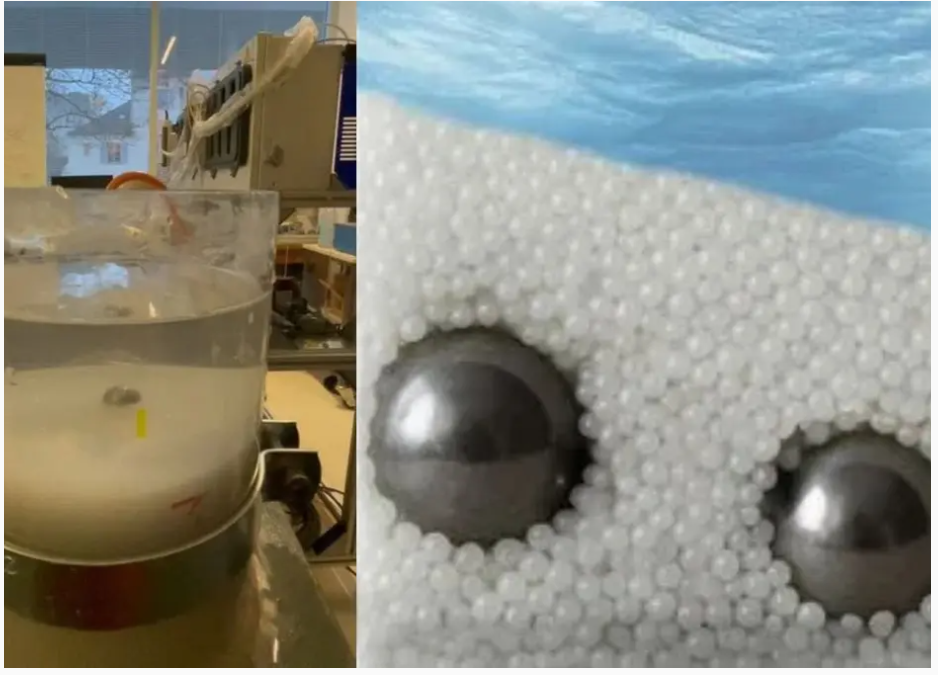
To solve this, the team initially studied objects in a clear environment and recorded how they scatter waves under ideal conditions. The pattern, or fingerprint, created by that, was then stored in a matrix. Eventually, the researchers send in ultrasonic waves when that same object is hidden in a complex environment — for instance a steel ball buried in sand.
While the majority of the waves will scatter chaotically, some of them will still interact with the buried object and thus carry traces of its fingerprint. As such, when comparing the measured signals with the stored fingerprint, the algorithm can identify the object’s location even though it cannot be seen directly.
“From the correlations between the measured reflected wave and the unaltered fingerprint matrix, it is possible to deduce where the object is most likely to be located, even if the object is buried,” the authors explained.
The team tested the system using steel balls buried in sand to determine if the system might be extended to medical scenarios.
During one trial, the team identified lesion markers designed to monitor breast cancer, which are often obscured by scattered signals in traditional scans.
During another trial, the technique was used to detect muscle fibers. This capability promises to advance the diagnosis of heart and muscular diseases.
For applications beyond medicine, the fingerprint matrix could also potentially be applied to optical imaging and other wave-based detection systems, the researchers concluded.