Team pings pipelines to identify lead water lines
Marie Donlon | March 30, 2024A team of Drexel University researchers is using acoustics to locate buried lead water pipelines associated with poisoning some of the U.S. water supply without digging them up.
To determine the composition of a pipe, researchers demonstrated that it was possible to tell the difference between lead pipes and those made from other materials based on the sound produced by striking the pipe and then monitoring the subsequent waves that reach the surface.
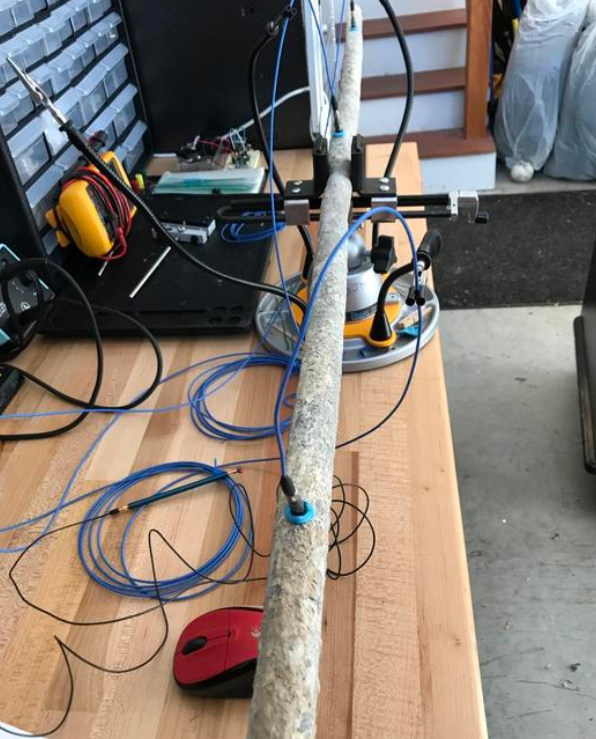 Source: Drexel Unviersity
By monitoring ultrasonic stress wave propagation — a method frequently used to assess the structural health of pipelines, railroads and aircraft wings — the researchers not only showed that different types of pipes produce distinguishable acoustic stress waves when struck, they also demonstrated that those waves are detectable at the surface level.
“Since wave speed varies with material type, the first arrival time of the wave on top of the surface differs for different service line materials,” the researchers wrote. “For instance, for lead, guided waves along the pipe are slower since lead bulk wave speeds are much lower than speeds of other service line materials.”
In the lab, the researchers experimented with lead, copper, steel and polyvinyl chloride (PVC) pipes. Piezoelectric accelerometer sensors were used to record stress wave propagation through each pipe as they were struck with a hammer. The experiment was repeated when each pipe type was partially filled with water and then again after each pipe type was buried underneath 30 cm of sand.
Using that data, the team created models called dispersion curves to show how quickly the waves reached each sensor as well as how their speed changed over time for each type of pipe as well as in different settings.
The team suggests that this approach could lead to the noninvasive identification of service lines and are working to develop a prototype system.
An article detailing the research, "Buried Service Line Material Characterization Using Stress Wave Propagation: Numerical and Experimental Investigations,” appears in the Journal of Nondestructive Evaluation.