Woodpecker-inspired drone reduces collision force by 70%
Marie Donlon | September 24, 2025A new fixed-wing drone capable of withstanding collisions has been developed by a team of researchers at the École Polytechnique Fédérale de Lausanne (EPFL), Switzerland.
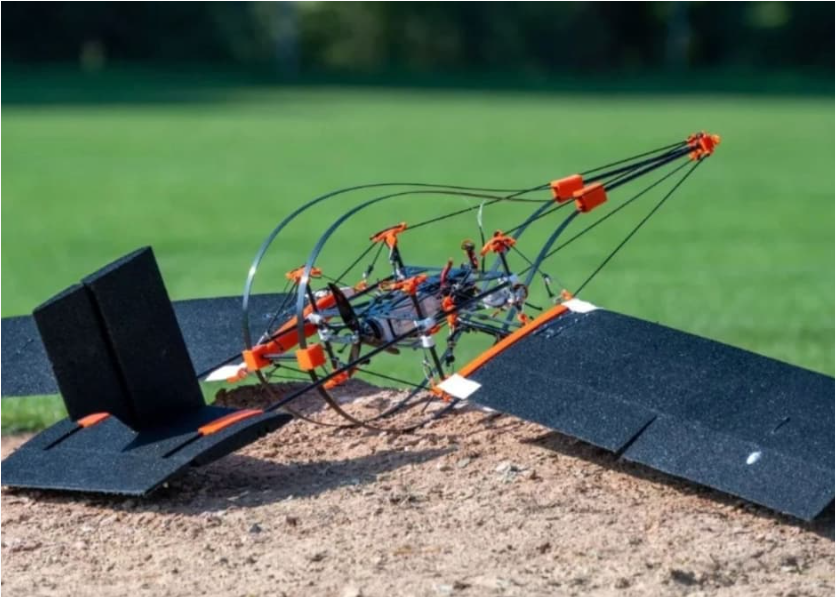
Taking inspiration from the unique head structure of a woodpecker, the team’s new aircraft, dubbed SWIFT, which is short for Shockproof Woodpecker-Inspired Flying Tensegrity, can reportedly survive impacts that would typically destroy similar drones.
 Source: EPFL Via IG/Edisonbilg
The SWIFT project is able to accomplish this by borrowing the structural principles from the woodpecker, which is able to repeatedly hammer its beak against trees without injury.
Making this possible is the structure of the woodpecker’s skull, which includes a rigid beak, a flexible hyoid bone that wraps around the skull and a layer of spongy bone between the hyoid and skull bone. This, combined with the extra free space surrounding the brain, enables the system to redirect impact forces away from sensitive tissues.
To replicate these features in the SWIFT drone, the team used tensegrity structures, which are lightweight, self-stabilizing frameworks of rigid and flexible elements held together via tension.
The team noted that carbon fiber rods serve as a stand in for the woodpecker’s beak, while bent carbon fiber strips serve as a stand in for the hyoid bone. Likewise, elastic cables serve as the spongy bone layer while carbon fiber plates connected with plastic brackets function as the skull.
Rather than protecting a brain, the system protects the drone’s electronic components, motor and propeller, which are suspended within the fuselage by rubber cables, which enable them to move up to 8.6 inches upon impact. This layout reportedly absorbs collision energy instead of transferring it to fragile components.
Further protection is offered in the SWIFT drone design thanks to a network of 12 elastic cables and carbon fiber rods connecting each wing to the fuselage. This structure reportedly reduces the risk of the drone’s wings snapping off upon impact.
The team suggests that the tensegrity-based systems dramatically increase the drone’s durability, thus reducing impact forces by up to 70% versus conventional drones of similar size and weight.
An article detailing the drone, “Collision-Resilient Winged Drones Enabled by Tensegrity Structures,” appears in the journal Advanced Robotics Research.
For more on the woodpecker-inspired drone, watch the accompanying video that appears courtesy of EPFL.