Can CCS decarbonize offshore oil and gas?
Tyler Gleckler | October 07, 2025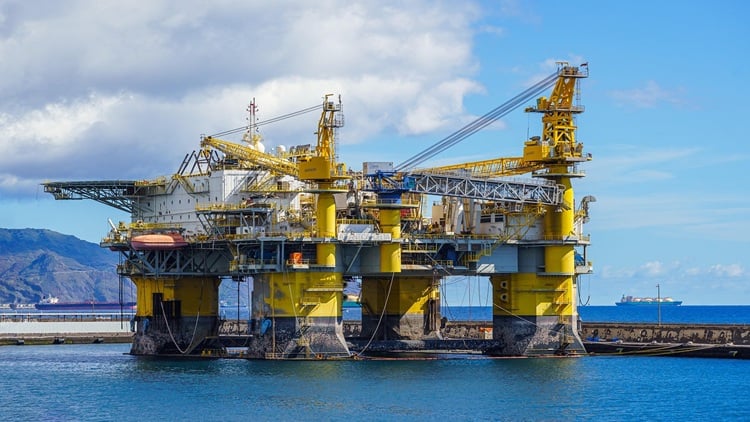 Source: Pixabay
Carbon capture and storage (CCS) is rapidly emerging as a cornerstone technology for a more sustainable oil and gas industry, and it’s already built into frameworks that will guide the world toward meeting emission reduction goals. CCS is relevant to both on- and offshore operations, but offshore CCS has distinct constraints as well as opportunities compared to its application onshore. Offshore CCS integrates the three primary stages of CCS — capture, transport and storage — into the existing architecture of an offshore asset or a nearby hub, and operators can capture carbon dioxide (CO2) from multiple sources simultaneously. This includes gas processing (acid-gas removal) on production trains, power generation on the platform or floater (gas turbines and reciprocating engines) or nearby industrial sources that deliver CO2 by pipeline or ship directly to an offshore storage site.
After first being captured, CO2 is dried and compressed (conditioning), and then moves to subsea wellheads, where the injection targets are deep saline aquifers or depleted fields with suitable pressure conditions and caprock integrity, together dictating the storage plan. However, while local conditions may dictate the nature of the storage plan, the storage permit, MMV (measurement, monitoring and verification) program and long-term liability framework define whether the chain operates as “permanent storage,” and thus earns regulatory credit.
Two features in particular distinguish offshore CCS from onshore projects, with the first being the space, weight and utility constraints at sea that force highly modular capture, dehydration and compression designs; equipment that readily fits on a brownfield refinery unit may not fit on a tension-leg platform, for example. The second is that offshore storage licensing, geomechanics, monitoring and many other key considerations are marine-specific (plume tracking, well barrier verification, etc.). These differences make offshore CCS a field-wide engineering and subsurface program instead of a bolt-on abatement, even though they are also the source of many of the remaining hurdles.
Why is offshore CCS important in 2025?
Offshore oil suffers from an emissions problem that CCS is capable of addressing directly. Scope 1 and 2 emissions from the global oil and gas value chain account for roughly 15% of energy-related greenhouse gases, with upstream combustion (power and heat), flaring, gas processing and venting disproportionately responsible. In the IEA’s Net Zero by 2050 framing, equipping oil and gas processes with CCS sits alongside methane mitigation and electrification as one of the core levers available to help halve the emissions intensity of global operations this decade. The reason is straightforward: offshore assets often rely on gas turbines that cannot be fully electrified (deepwater, long step-out from shore power), and gas processing units at high-CO2 fields already separate CO2 streams that can be conditioned for storage. Therefore, CCS complements, not replaces, the platform electrification and methane initiatives by picking up residual combustion and process CO2 that otherwise persists. Offshore CCS is a means of targeted decarbonization, best suited where process CO2 is already separated or when there is a nearby storage hub.
Fortunately, commercial drivers are aligning, as carbon cost exposure (compliance markets and offtake specifications), capital discipline on late-life fields and the emergence of shared transport-and-storage companies in mature basins make CCS a system choice. When a storage hub sits within reach of several platforms, whether by ship or pipeline, operators can decouple capture deployment from the pace of storage appraisal, and they can decommission in an orderly way to avoid leaving stranded pore space value. The portfolio logic matters more offshore than onshore because individual tie-backs rarely justify custom storage alone.
Engineering struggles at sea
For all the advantages specific to offshore CCS, there are still several hangups; engineering is far less forgiving at sea. Post-combustion carbon capture on gas turbines requires large absorbers or rotating contactors, as well as additional heat integration, solvent management and careful aerosol control. Collectively, that adds significant weight and footprint to a topside that may already be mass-constrained; the parasitic power draw complicates utility balances and can force uprating of compression or the addition of waste-heat recovery. On floaters, motions affect column hydraulics and rotating equipment, and on fixed platforms, brownfield tie-ins compete for space with essential safety equipment. Both are solvable, but they shrink margins on availability as well as on operability, especially for small or cyclic facilities, in addition to satellite assets.
Comparing offshore capture-power concepts to unabated references reveals material efficiency penalties and significant space/weight demands, even when strong heat-integration and combined-cycle options are employed. That pushes designs toward modular capture units, partial capture of the highest-emitting sources first, or routing power generation off the asset entirely (i.e., electrification) while capturing process CO2 where separation already occurs. None of those choices is necessarily the “wrong” one; the “right” answer simply depends on the platform layout, field life, storage distance and other site-specific considerations.
Transport and storage, no small part of what is encompassed by offshore CCS, create a second cluster of hangups. CO2 quality specifications offshore are tight because water/oxygen and sulfur-containing compounds fuel the risk of corrosion and hydrate formation in subsea systems, so meeting those specs offshore stresses dehydration and materials selection. On the storage side, operators must manage reservoir pressure in stacked or compartmentalized formations as well as prove isolation from legacy wells, where appropriate. Seismic and geodetic monitoring underwater is established, but it is still costly at the hub scale, so pragmatic MMV schemes thus need to balance resolution against OPEX. The commercial model, or who books capacity, how take-or-pay works through downtime and how to allocate plume-related liabilities, remains unfamiliar territory for many upstream joint ventures.
Realizing offshore CCS at scale
To achieve scalable offshore CCS, the first hurdle, before any technical hurdles, is to ensure that cross-border CO2 movements to offshore sinks have an unambiguous legal footing. Many viable reservoirs lie under maritime boundaries or are best utilized as regional hubs that take CO2 from multiple countries, painting an often complicated legal picture. Clarifying and widening the legal pathway is the difference between one-off demonstration shipments and an integrated, multi-basin network for maximum impact.
With a clear legal footing, the next hurdle to overcome is storage governance, which must be highly predictable. Offshore CCS depends on the clarity of long-term liability transfer, as well as on the depth of monitoring expectations and the mechanics of storage permit variations when new injectors, formations or users join a hub. Jurisdictions with detailed offshore storage regimes already require corrective measures plans, periodic permit reviews and financial security that survives closure; everywhere else, comparable elements will be necessary, but with flexibility to accommodate local geology and legacy well density.
Upstream integration must be deliberate. Capture should be scoped with late-life field physics in mind. Tie-back strategies should consider whether a small satellite’s emissions belong on a shared capture unit at the host or on a skidded package nearby. Subsurface teams must plan plume management and pressure control alongside hydrocarbon production, not after it. And decommissioning schedules should line up with storage plateau and post-closure monitoring commitments to avoid dismantling critical infrastructure prematurely.
Finally, project delivery needs repeatable kit and standard contracts. Modular capture equipment sized for the envelope of typical platform flue-gas streams; standard CO2 specification tables for subsea pipelines and ship unloading; and template tariff structures for third-party access will reduce FEED times and financing friction. None of this requires breakthrough science, but rather fit-for-purpose standardization, the kind that offshore wind and LNG developed with time.
CCS’s pipeline to portfolio instrument
Offshore CCS will not decarbonize every offshore barrel, and it should not try to. Electrification from shore or offshore wind will often beat post-combustion capture on space- and weight-limited platforms; methane abatement is still the fastest win almost everywhere. But when facilities must keep on-asset power, when gas processing already produces a concentrated CO2 stream, or when a regional storage hub sits within pipeline or shipping reach, CCS is indeed the decisive lever for residual emissions.
Ongoing research suggests that CCS is technically feasible offshore, albeit with meaningful efficiency and footprint costs; the policy record shows cross-border rules exist in provisional form but need consolidation. Pair those with pragmatic storage governance and a standardized kit, and offshore CCS shifts from custom pilots to a portfolio instrument that operators can deploy where it fits the geology as well as the finances. That is the sober, defensible path: use CCS offshore where it is system-rational, provide it at multi-user hubs and insist on legal certainty that scales.