New wearable patch performs diagnostics using sweat, not blood
Marie Donlon | September 21, 2025A new smart patch that can precisely assess the body's health status using sweat instead of blood has been developed by a KAIST research team.
According to its developers, the smart patch can precisely observe internal changes through sweat when attached to the body. There, it can simultaneously and in real-time analyze the multiple metabolites present in sweat.
Previously, wearable sensors that analyzed metabolites in sweat to monitor the human body's health status relied on standard "label-based" sensors, which required fluorescent tags or staining and "label-free" methods. However, these approaches have encountered challenges in collecting and controlling sweat. As such, there have been limitations in accurately observing metabolite changes over time in actual human subjects.
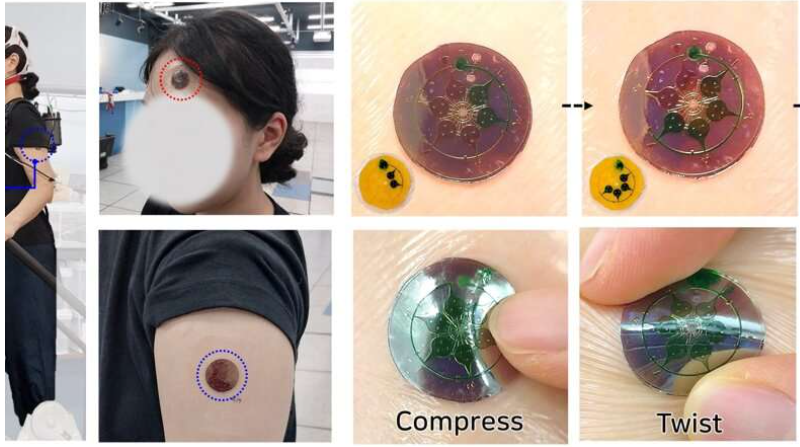 Example of the fabricated patch worn (left) and images of sequential sweat collection and storage (right). By designing precise microfluidic channels based on capillary burst valves, sequential sweat collection was implemented, which enabled label-free analysis of metabolite changes associated with exercise and diet. Source: Nature Communications (2025). DOI: 10.1038/s41467-025-63510-2
To overcome these challenges, the team created a thin and flexible wearable sweat patch that directly attaches to the skin and incorporates both microchannels for collecting sweat and an ultrafine nanoplasmonic structure for analyzing components using light. Due to this construction, multiple sweat metabolites can be analyzed at once without the need for separate staining or labels.
The team explained that a nanoplasmonic structure is an optical sensor in which nanoscale metallic patterns interact with light, allowing for the highly sensitive detection of molecular presence or concentration changes in sweat.
To create the patch, the team combined nanophotonics technology — which manipulates light at the nanometer scale, about one hundred-thousandth the thickness of a strand of human hair — to analyze molecular properties, with microfluidics technology, which directs sweat through channels finer than a single strand of hair.
Using a single sweat patch, microfluidic technology allows for sweat to be collected sequentially over time, which subsequently enables the measurement of changes in assorted metabolites without any labeling process. There are approximately six to 17 chambers — or storage spaces — within each patch. When sweat is secreted during exercise, it flows along the microfluidic structures and fills each chamber in order.
During trials, the patch was worn by human subjects, and it continuously tracked the changing components of sweat over time as the wearers exercised. In earlier iterations of the patch, only about two components could be checked at once using a label-free approach. However, using this new approach, the team could quantitatively and simultaneously analyze three metabolites — uric acid, lactic acid and tyrosine — and how they changed in response to exercise and diet.
Further, the team used artificial intelligence (AI) analysis methods to recognize signals of desired substances within the complex components of sweat.
"This research lays the foundation for precisely monitoring internal metabolic changes over time without blood sampling by combining nanophotonics and microfluidics technologies,” the researchers explained. “In the future, it can be expanded to diverse fields such as chronic disease management, drug response tracking, environmental exposure monitoring, and the discovery of next-generation biomarkers for metabolic diseases."
An article detailing the team’s work, “All-flexible chronoepifluidic nanoplasmonic patch for label-free metabolite profiling in sweat,” appears in the journal Nature Communications