Bacterial cellulose dressing stops bleeding fast, boosts burn wound treatment
Marie Donlon | August 25, 2025A research team from Shenzhen Institute of Advanced Technology of the Chinese Academy of Sciences has developed a bacterial cellulose (BC)-based hemostatic dressing that promises quick and sustained bleeding control.
The team noted that they turned to BC for use as a wound dressing material because of its microporous structure, mechanical strength, breathability and biocompatibility. However, the team found that BC lacks intrinsic bioactivity, particularly hemostatic properties, thus limiting its effectiveness in complex wound situations.
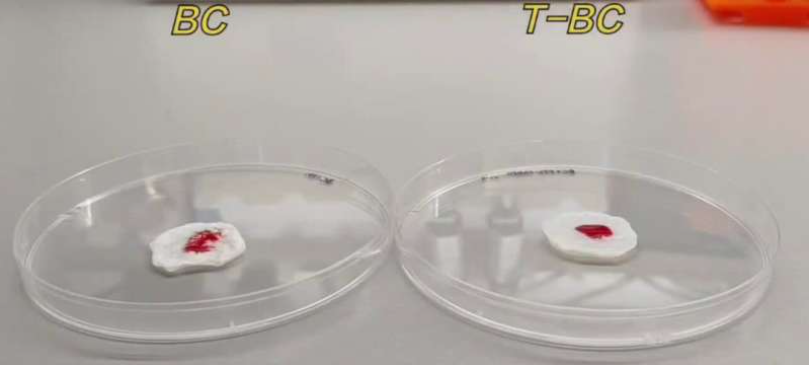 In vitro coagulation performance of BC and T-BC dressings observed 1 minute after blood application. Source: Advanced Materials. DOI: 10.1002/adma.202420338
To address this, the team developed a synthetic bioengineered solution by anchoring human-derived thrombin onto a BC matrix using a cellulose-binding domain (CBD). This created a thrombin-anchored BC (T-BC) composite dressing that encourages rapid hemostasis and wound healing, while still preserving T-BC's nanomesh structure, breathability and biocompatibility, while also enhancing its hemostatic properties via protein engineering.
When trialed using in vitro coagulation tests, the team confirmed the dressing's hemostatic performance. Moreover, in a rat liver incision model, the T-BC dressing achieved hemostasis in just one minute — reportedly outperforming other commonly used materials.
Additionally, in a simulated deep second-degree burn wound model, T-BC-treated wounds exhibited significantly accelerated healing, with wound closure rates roughly 40% higher than those of the control group after just five days.
The team explained that genetic-level analyses revealed that the T-BC dressing accelerates wound healing via a triple synergistic mechanism: by promoting neovascularization, by modulating inflammatory responses and by facilitating the reconstruction of skin tissue architecture. Together, this enables precise molecular regulation of the healing process.
Further, the biomolecular self-assembly strategy encourages thrombin immobilization via immersion in a mild protein solution, thereby eliminating the need for harsh chemicals or conditions often associated with chemical crosslinking.
The dressing is detailed in the article, ”Thrombin‐Anchored Bacterial Cellulose Dressing for Advanced Burn Wound Care,” which appears in the journal Advanced Materials.