Cobots enter the cleanroom workspace
Jon Lowy | July 18, 2025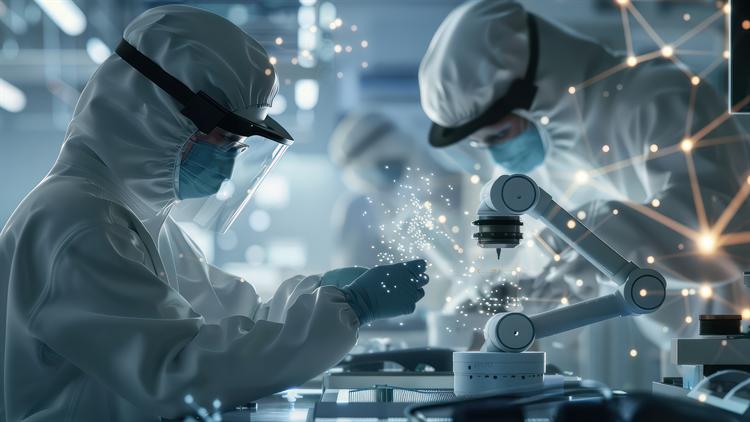 Source: Johannes/AdobeStock
Cobots are revolutionizing various industry sectors, as they work alongside humans to safely and efficiently complete strenuous, monotonous or delicate tasks.
In clean room environments, those with ultra-tight contamination protocols, such as those found in semiconductor manufacturing, pharmaceuticals and biotechnology, recent innovations have significantly expanded cobots' utility. Cobots, by nature, are designed to work alongside humans, which means a higher standard on systems design to begin with. This lends itself to the clean room environment, although additional design criteria must be examined.
With new standards and certifications, rapidly improving control technologies and enhanced capability, cobots are becoming a requisite contributor to industries using clean room environments.
Cobot design for clean rooms
A notable development is the growing number of cobots engineered specifically to meet strict cleanroom requirements. Cleanroom-grade cobots must include different design concepts than their factory-floor brethren, which are often deployed in dirty or greasy conditions where subtractive particles, oils and solvents, and pollutants are all potentially present.
Equipment destined for a clean room must have sealed joints that can contain wear particles or lubricant leaks from power transmission and motion control systems. Also, many of these systems are simplified by increased used of technologies like stepper motors and servos.
The equipment must also be easily deep cleaned. This includes materials that are resilient to UV and detergents, but also minimize pores, cracks or other surface defects that can harbor contaminants. New material and manufacturing methods are delivering reduced contaminant adherence, self-cleaning or anti-microbial surfaces.
There must also be consideration for the robots' power supply and materials needs. Stationary robots are perhaps best situated along the perimeter of the clean room, so that cabling and other fittings can rest outside the clean room. Battery powered mobile robots are another option. Autonomous mobile cobots (AMCs) or compound robots improve dynamic cleanroom workflows by taking over transport and material placement roles.
For instance, Hanwha's collaborative robot lineup has received ISO Class 2 certification, making it suitable for highly controlled environments. Manufacturers such as Universal Robots, KUKA and Stäubli have introduced cobots with materials and lubricants that minimize outgassing, which is a common micro-contaminant concern in cleanrooms. These robots also feature cleanroom-optimized cabling and coverings to support compliance with ISO and GMP (Good Manufacturing Practice) standards.
Advanced sensing increases application range
Increasingly, cobots in general are equipped with advanced sensors, cameras/visual processing and artificial intelligence (AI)-powered processors that allow for real-time environmental adaptability. These technologies enable cobots to operate in close proximity to humans, identify and manipulate delicate components, and undertake exacting QA.
AI integration is also enabling predictive maintenance and process optimization. Engineers and operators can have high predictability about machine throughput and maintenance status, thanks to historical data sets that improve analysis over time. The result is a machine that has maximum uptime and reliable productivity.
Two fundamental clean-room operations that are enhanced by use of cobots are wafer handling in lithography production and sterile handling in pharma production. Both of these functions enhance output quality and remove people from essentially mundane transport operations.
Traditionally, cobots in cleanroom environments were limited by payload capacity. That is changing with the introduction of high-payload collaborative models like the FANUC CR cobots, which can handle up to 50 kg. This enables the handling of heavier components, expanding accessible roles from inspection to full assembly and transport tasks. This means they can also handle heavy objects, like chip die castings.
Higher payloads also mean that cobots can be equipped with more sophisticated tooling and end-effectors, including vacuum grippers and force-torque sensors tailored for delicate or sterile handling. Advanced haptics allow increasingly delicate manipulation of materials and components with greater error detection, awareness and correction.
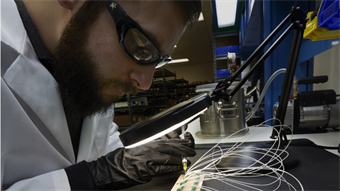
Performing tasks like micro-welding, optical alignment, or mounting surface-mount technology (SMT) components on circuit boards are increasingly handled by cobots. A task like welding, if carried out by hand, is physically strenuous and can be anxiety-inducing when working on sensitive, microscopic components. Cobots are adept at this type of task and role.
Finally, upon completion of chips and pharma products, flexible cobots are increasingly integrated in automated box loading, foil sealing and blister packing with consistent accuracy and cleanliness. In these and diverse other roles, cobots offer both repeatability and scalability.
Future Outlook
The archetypal image of the dirty robot - one that is greasy, covered in dirt and hauling raw materials - is outdated. As more companies seek to reduce labor costs and improve quality, automated clean rooms exploiting cobot technologies offer a glimpse of what's to come.
The demand for cobots in cleanrooms is undergoing growth in sectors like pharmaceuticals, where precision and sterility are critical, and in semiconductor fabrication, which demands extreme cleanliness and reliability.
Another archetype of robots: they're here to take jobs. Did you know the number one source of contaminants in clean rooms are the human personnel? Cleanroom environmental control would be more stable without the presence of humans at all.
These ideas will continue to push the boundaries of what cobots can achieve in controlled environments, making them increasingly important assets in next-generation manufacturing.