
It's a boat! It's a plane! It's an...ekranoplan!?
Andy Tomaswick | July 15, 2025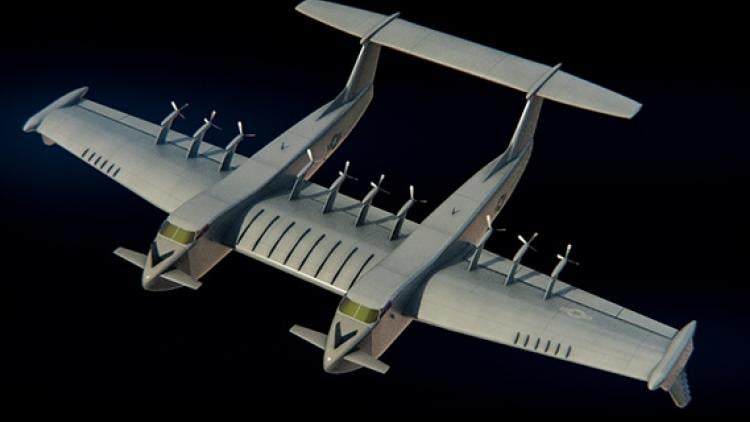
Some transportation technologies improve quicker than others. Certain improvements to lighter-than-air blimps or flying cars have been in the idea stage for decades, but face many challenges to re-enter the commercial mainstream. Another fledgling transportation mode that has been grounded for decades might be finally getting its turn for renewed interest.
Ekranoplans, or wing-in-ground effect vehicles, are starting to garner more interest and a few prototypes are in development or may be operational soon. Before long, heavy lift vehicles, and perhaps even unmanned drones, could be zooming just above the water, combining the features of boats and planes into a new, more efficient mode of transportation.
What is an ekranoplan?
Ekranoplans work using a scientific principle called the wing-in-ground (WIG) effect; in fact they are more commonly called WIG vehicles or ground-effect vehicles, although this latter term also includes hovercraft. Ekranoplan is a genericized term, that's what the Russians call their designs.
Regardless of name, the defining characteristic is that they fly close to the ground (or more likely the water), taking advantage of a unique physical phenomena that happens when doing so. First, the air underneath their wings becomes compressed due to the proximity of the craft to the Earth’s surface. Second, the forces of air traveling around the wings interrupt the formation of vortices behind the wing.
A typical airplane wing pushes air down, and uses the increased pressure underneath it to create lift — you know, Bernoulli’s principle. However, since ekranoplans fly so close to the ground, the air pushed down by the wing tips doesn’t simply disperse; it compresses. The surface acts as a physical barrier, creating additional pressure in the air underneath the ekranoplan, increasing its lift compared to the same amount of air pressed down by traditional plane wings. Notably, pilots flying traditional aircraft feel this effect when they are operating close to the ground, with some describing their planes as floating near the ground while they are trying to land. (That's better than sinking.)
But perhaps the more interesting phenomena caused by the ground effect is the disruption of vortices behind the craft’s wings. These vortices, which are formed when higher pressure air from behind a wing attempts to flow around its end to the lower-pressure upper side, cause a significant amount of induced drag, slowing the airplane and increasing its fuel consumption to travel at the same distance and speed.
This occurs in any object moving through a fluid that is creating turbulent airflow. In recent years, many airplane designs have added winglets, which helps weaken vortices. Many large trailers on long-haul highways deploy a spoiler for this purpose, too.
The variable aerodynamics caused by the WIG effect effectively scatters these vortices, thereby eliminating a significant source of induced drag present in traditional airplanes. This effect is very different from traditional hovercraft, which actively push air downwards using fans to create an active cushion of air between themselves and the ground. Ekranoplans don’t actively create that cushion, and instead rely on the traditional lift of airplane wings and use the aerodynamics of the air pushed downwards by their wings to act as an added bonus.
While in theory this effect could work over either water or solid ground, most ekranoplans are designed for use over water, specifically lakes, seas and oceans. This is because the relative stability of the height of these surfaces, and vast wide open spaces, make the ekranoplan much easier to control.
Another major ekranoplan advantage: they don’t need runways. Outfitting with floats, similar to a traditional seaplane, allows them to use any relatively calm water surface as a port. Those features make them particularly attractive to one kind of customer: the military.
 The Lun-class ekranoplan (aka Caspian Sea Monster), was in service with the Russian Navy for about a decade, beginning in 1987. Today it is a monument in a military park in Russia. Source: Alexey Komarov/CC BY-SA 4.0
Early ekranoplans, such as the Caspian Sea Monster, were designed with military uses in mind. They were intended for quick transport of large goods, troops and equipment over relatively long distances. Ekranoplans could fly low enough to be difficult to track using radar and also would be out of the water to avoid some submarine and anti-ship weaponry.
Roles in military and civilian use
Interest in ekranoplans from militaries around the world continues to the modern day. Currently, the U.S. Defense Advanced Research Projects Agency (DARPA) is sponsoring a project called the Liberty Lifter, which will be a WIG design that will carry as much as a C-17. The Liberty Lifter will be able to support maritime sealift operations by quickly delivering payloads without airfields. Notably, Liberty Lifter will also be able to fly up to 10,000 ft, if needed.
Traditional sealift is slow and requires port access, which is more difficult during combat. Airlift has careful payload limits, requires long runways and cannot directly serve coastal areas. Liberty Lifter can solve for all of those, provided research teams meet three critical criteria.
- The craft must be able to operate on rough seas, provide adequate maneuverability and serve extended ranges.
- The craft must be inexpensive and forego most aerospace design and material concepts.
- The vehicle must be somewhat autonomous, guiding pilots through varying weather and sea states.
With a potential launch date of 2028 or 2029, the project is currently in the preliminary design phases and being led by a company called Aurora Flight Sciences. Their business development director noted in a recent interview that DARPA will have to make a decision this summer about whether or not to allow the project to fall by the wayside.
(Editor's note: This indeed occurred. Just several days ago, DARPA discontinued this project.)
But even if the U.S. doesn’t pick up the mantle of ekranoplan development, others certainly might. Poland’s defense industry is actively working on a WIG drone. Recent reports state that a Chinese ekranoplan is operating off Taiwan.
But destroying enemy targets or tracking their movements aren’t the only use cases for these craft — there are plenty of civilian uses as well. Several companies from various countries are working on developing systems that focus on tasks ranging from maritime rescue to tourism.
Widgetworks, a company based out of Singapore, is working on a system called the Airfish-8. Originally developed back in the late 1990s, this prototype has undergone several full overhauls over its multi-decade development history. Its reverse delta-wing design strikes a unique physical appearance, though the operational principles are the same as other WIG aircraft. Widgetworks recently entered into a partnership with ST Engineering, a global engineering company, to bring a fully functional system to its first customer, which intends to use the craft for tourism around Turkey in 2025.
Another civilian craft is the Viceroy Seaglider, made by the U.S.-based Regional Electric Ground Effect Nautical Transport (REGENT). It has the distinction of being driven by an entirely electrical propulsion system, though it will still use turboprops like many other ekranoplans. It is already relatively far down the development path, with sea trials beginning this past March. There has already been plenty of interest from customers, with an estimated 600 orders already placed, some of which were by existing investors in the company.
A wavy horizon
Whether it be tracking submarines or flying exuberant passengers around Hawaii's islands, it seems the time of the ekranoplan might be about to dawn. Engineers have made big strides toward tackling some of the challenges that grounded ekranoplans long ago — chiefly maneuverability and low durability in challenging seas.
After decades of development stagnation, technology has finally advanced enough to make these unique craft viable in a number of rolls. At this point, it appears to be only a matter of time before they will take to both the sea and sky, but it remains to be seen how disruptive they might be to how maritime transport is done.



I thought Bernoulli's Principle, relating to lift from a wing, was due to higher velocity airflow on top of the wing creating lower pressure on top.
I'm a downwash theorist myself.
The Russian craft looks like something straight out of Mad Max.