From powder to prototype: Laser sintering accelerates medical device innovation
Jody Dascalu | August 15, 2025Prototyping plays a central role in the development of medical devices, allowing engineers and clinicians to evaluate form, fit and function before committing to full-scale production. In a field where precision and customization are critical, fast and flexible fabrication methods are essential. Among the various technologies available, selective laser sintering (SLS) is a practical solution for producing strong, detailed components with complex geometries.
SLS builds parts by fusing powdered materials layer by layer using a focused laser. This approach enables the creation of durable prototypes that can withstand mechanical testing and real-world handling, making it particularly useful for surgical tools, orthotic components and patient-specific models. As medical device design cycles become increasingly iterative and tailored, SLS offers a reliable path from digital concept to physical validation.
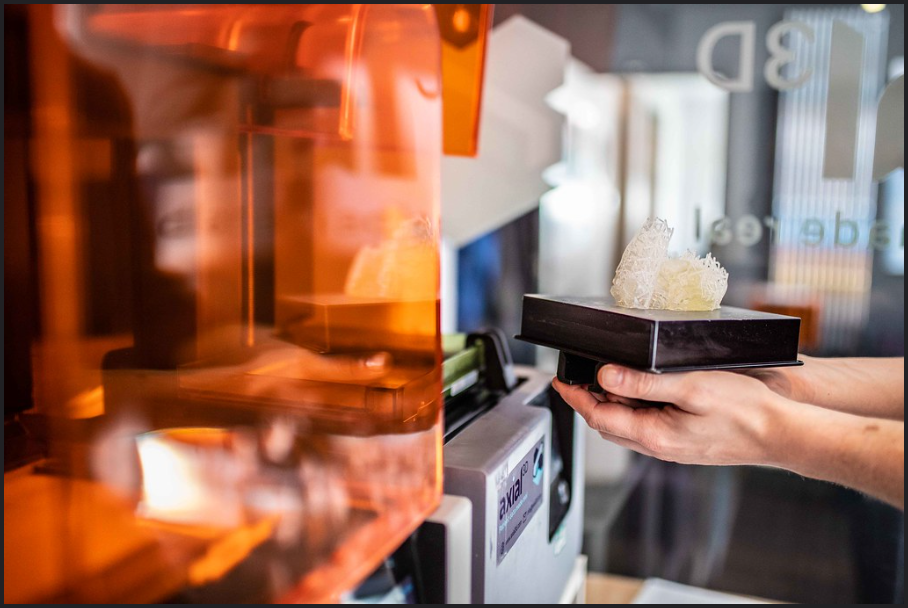 3D printed medical model. Source: This is Engineering/Flickr
Process overview and fabrication method
SLS is a fabrication method that builds objects by sintering powdered material layer by layer with a high-powered laser. The laser selectively fuses particles in a powder bed according to the cross-section of each digital slice, gradually forming a solid, three-dimensional part without the need for support structures.
SLS commonly uses thermoplastics such as nylon (PA12), TPU and glass, or carbon-filled variants. These materials offer a strong balance of flexibility, durability and heat resistance, making them suitable for functional medical components and working prototypes.
Compared to other fabrication methods like stereolithography (SLA) or fused deposition modeling (FDM), SLS produces parts with greater mechanical strength and design freedom. Unlike SLA, which uses liquid resins, or FDM, which deposits melted plastic through a nozzle, SLS allows for the creation of intricate, interlocking designs and enclosed geometries. As one of the more established powder-based additive manufacturing techniques, it supports rapid iteration without compromising structural performance.
Material characteristics and design flexibility
SLS presents several technical advantages that make it suitable for prototyping functional medical components. A key feature is its ability to produce complex geometries without support structures. The powder bed provides uniform support during printing, allowing for the fabrication of internal channels, lattice features, and moving elements in a single build. This is particularly relevant for components that must accommodate anatomical geometry or interact with other mechanical systems.
SLS-printed parts made from materials such as PA12 and composite variants demonstrate favorable mechanical properties, including tensile strength, impact resistance and dimensional stability. These characteristics enable physical prototypes to be evaluated under handling, assembly or simulated-use conditions.
In some use cases, the availability of biocompatible material grades extends the applicability of SLS to early clinical environments. Certain certified PA12 formulations may be suitable for components with limited patient contact, such as anatomical models or surgical positioning guides. Regulatory considerations still apply, but the ability to produce prototypes without custom tooling can streamline early development.
SLS also supports accelerated design cycles. Once a digital model is prepared, parts can be produced within hours. This enables parallel testing of design variants and reduces wait times between iterations. The combination of fabrication speed, structural performance and geometric flexibility makes SLS a practical option for many medical prototyping workflows.
Use cases in device prototyping
SLS is well-suited for early-stage development of medical devices where functional requirements and patient-specific constraints must be addressed simultaneously. The process enables the production of enclosed, articulated or mechanically functional geometries without the need for assembly or secondary operations. As a result, working prototypes of surgical tools, orthotic components or implant trial parts can be fabricated and tested under simulated use conditions, including loading and sterilization.
The ability to produce models directly from patient imaging data also supports applications in personalized medicine. Custom-fit anatomical guides, splints and orthoses can be designed and manufactured to match individual geometry. This is relevant in cases where standard devices are insufficient, including complex fractures, post-operative care or structural corrections.
SLS is also used for form-fit-function testing prior to molding or machining. Engineers can verify tolerances, assess assembly performance and conduct ergonomic evaluations through physical interaction with the printed part. The dimensional stability of SLS output supports iterative refinement before committing to final tooling.
In preclinical workflows, SLS components are used for benchtop testing, fixture alignment and regulatory documentation. Their repeatability and structural consistency help reduce variability across validation procedures. This makes SLS a practical method for supporting multiple stages of medical device development, from concept evaluation to submission preparation.
Technical limitations and regulatory factors
While SLS is effective for prototyping, it has limitations that impact medical applications. Surface finish is often rough due to residual powder, requiring post-processing such as blasting or coating, which adds variability. Material certification is also non-automatic, biocompatibility depends on both the polymer and print environment, requiring validation for clinical use.
High equipment costs and environmental requirements may limit accessibility, especially for smaller teams. While service bureaus offer access, lead times and preparation steps can reduce flexibility. SLS is also generally restricted to prototyping; standard polymers may not withstand sterilization or meet durability standards for implants. Most applications remain focused on development and evaluation rather than final-use production.
Industry implementation and workflows
SLS has been adopted across the medical device sector to support early-stage prototyping. Developers have used PA12 components to iterate on surgical tools, refining features like handle ergonomics and articulation without retooling. Orthopedic startups have applied SLS to create patient-specific braces from scan data, enabling early evaluation of fit and durability. Larger OEMs use SLS for anatomical models and device positioning jigs in cadaveric studies, improving consistency in preclinical workflows. These examples illustrate how SLS supports iterative design and physical validation across a range of medical applications.
Outlook for clinical integration
The role of SLS in medical device development is evolving as materials, software and validation processes continue to mature. While the technology is currently used primarily for prototyping, there is steady movement toward more integrated design-to-manufacture workflows. Advances in simulation, modeling and anatomical segmentation are improving the precision of early-stage designs, reducing the need for repeated physical iteration and enabling better alignment between digital planning and printed output.
At the same time, research into medically relevant materials is expanding the potential range of SLS applications. As process monitoring, traceability and post-processing standards become more consistent, limited clinical use, particularly in low-volume, patient-specific manufacturing, may become feasible. Although significant regulatory hurdles remain, the trajectory of development suggests that SLS could gradually shift from a prototyping tool to a specialized production method within targeted areas of healthcare.