Testing a safer nuclear fuel
S. Himmelstein | July 10, 2025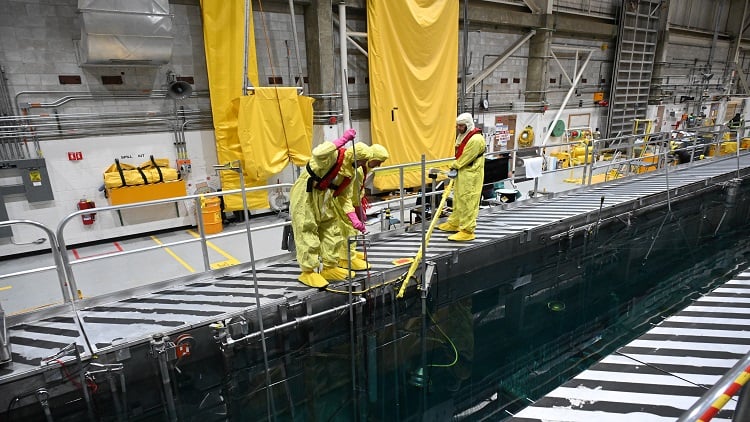 Experimental fuel capsules being staged at the Advanced Test Reactor. Source: Clean Core Thorium Energy
A proliferation-resistant nuclear fuel design formulated by Clean Core Thorium Energy is being tested at U.S. Idaho National Laboratory (INL) facilities to demonstrate its performance and safety benefits for pressurized heavy water reactors and CANDU reactors.
The Advanced Nuclear Energy for Enriched Life (ANEEL) fuel combines thorium with high-assay low enriched uranium, which is enriched to between 5% and 20%. Typically, uranium in pressurized heavy-water reactor fuel is not enriched, meaning the fissionable uranium-235 element makes up less than 0.72% of the total. The new nuclear fuel recipe can be consumed without requiring any modifications to the reactor or fuel bundle external geometry. Unlike conventional fuel pellets, the ANEEL fuel is fabricated with a hole in the center of the pellet to better accommodate fission gas release at high burnup.
The INL Advanced Test Reactor recently tested 12 ANEEL fuel rodlets under high neutron flux accelerated burnup conditions, achieving burnup levels 3.5 to 4 times higher than those of traditional natural uranium. Four rodlets will now undergo post-irradiation examination, while the remaining eight will continue accelerated irradiation to over 60 gigawatt-days per metric ton burnup.
Initial results reveal no obvious cracks in the fuel, no collapse of the annular fuel form and no gross deformation of the rodlet. The tested material will next be the focus of profilometry, which measures the rod’s surface looking for physical dimensional changes, and detailed gamma scanning to map fission-product distribution in the fuel.
Finally, the fuel rodlets will be disassembled so the fuel pellets can be inspected. Because the fuel rodlets must be cut open to access the fuel pellets, these types of exams are known as destructive examinations. Destructive examinations will include collecting fission gases within the fuel pin and using microscopy on individual fuel pellets to examine the effect that irradiation has on the fuel’s microstructure.