
Upping uranium fuel enrichment
S. Himmelstein | May 01, 2025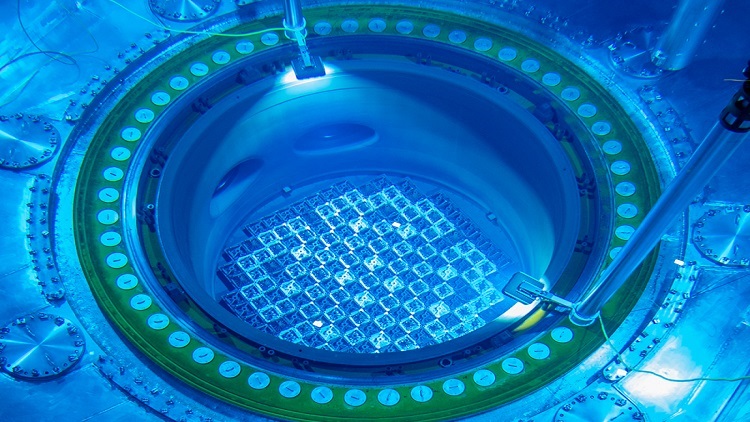 The enriched rods being installed in the reactor. Source: Southern Nuclear
A new form of highly enriched nuclear fuel is being tested at the Vogtle Unit 2 reactor in Waynesboro, Georgia. This marks the first time fuel enriched above 5% will be irradiated in a U.S. commercial reactor. The uranium fuel was developed through the U.S. Department of Energy Accident Tolerant Fuel Program to help improve fuel cycle safety and lower operational costs.
Southern Nuclear recently loaded four lead test assemblies containing Westinghouse Electric Company's ADOPT fuel pellets, enriched up to 6 weight percent of uranium 235, into the reactor. The higher enrichment levels are expected to allow the fuel to last longer and operate at increased power levels, enhancing the merits of nuclear power production. Commercial reactors currently operate on fuel that typically ranges between 3% and 5% enrichment.
The advanced uranium dioxide fuel is doped with chromia and alumina to increase uranium density, improve thermal conductivity, and reduce gas released by the fission process that can damage fuel. The increased thermal stability allows for more accurate prediction and enhanced control of pellet-cladding gap closure. The higher level of enrichment could also help extend operation cycles from 18 to 24 months and reduce the amount of waste generated.
During the next four and a half years, the fuel will be examined after each fuel cycle to assess its readiness for wider deployment.




Why do we need to enrich uranium? If we can get Gen IV (fast) reactors approved, enrichment will not be needed (except for initial startup as I understand.) A fast reactor will operate on U-235, U-238, natural uranium (mostly U-238,) thorium, and the reprocessed waste from thermal reactors.