Can amine-based carbon capture lead refineries to carbon-neutral operations?
Tyler Gleckler | May 16, 2025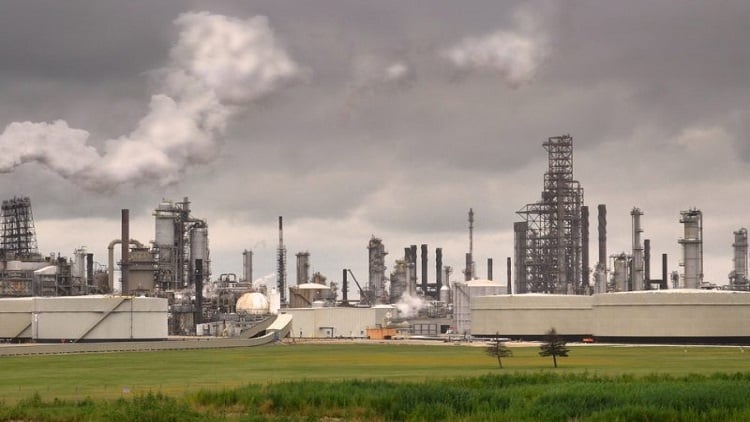 Source: Richard Hurd/CC BY 2.0
Refineries are major contributors to global carbon dioxide (CO2) emissions, accounting for roughly 4% (approximately 1.5 GTs) of worldwide CO2 output. In the global race to reduce carbon emissions, motivated by international climate commitments and guided by intergovernmental bodies, rapid scale-up of industrial carbon capture is understood as an essential tactic in the broader emissions reduction strategy. Indeed, the International Energy Agency’s (IEA) Sustainable Development Scenario envisions 2.8 billion tons of CO2 per year being captured and stored by 2050; at today’s approximately 40 million tons of CO2 captured, closing the gap requires refineries to join the race. Fortunately, carbon capture and storage (CCS) solutions are increasingly being integrated into both new and old refineries, and there’s one preeminent technology currently responsible for the bulk of the capture: amine-based capture, also known as amine-based scrubbing. It's become the workhorse technology for removing CO2 from flue gases, but emerging methods are likely to join its ranks for more widespread and effective carbon capture at refineries.
A technical overview of amine-based carbon capture
Amine-based carbon capture is a post-combustion CO2 removal process that uses chemical solvents to extract the gas from flue gases. In a typical system, exhaust gas from refinery process heaters or other units is passed through an absorption column containing an aqueous amine solution. Here, the amine solvent chemically binds CO2, forming compounds such as carbamates and bicarbonates. The CO2-depleted flue gas then exits the absorber while the CO2-rich solvent is routed to a regeneration column (stripper). There, heat (usually from steam) is applied to break the CO2–amine bonds, releasing concentrated CO2 gas and renewing the solvent. The stripped CO2 is then cooled, dried and compressed for transport or storage, and the regenerated amine is recycled to capture more CO2.
This closed-loop solvent process can typically capture a large fraction of the CO2 (often ~90%) from the treated gas stream. Amine scrubbing is thus considered the most mature carbon capture technology, with decades of use in natural gas processing and industrial gas sweetening. However, the solvent regeneration step is energy intensive, contributing to significant operational cost and complexity. Regardless, amine-based capture offers a proven method to substantially reduce CO2 emissions from refinery operations by absorbing and isolating carbon dioxide before it can enter the atmosphere.
How is amine-based carbon capture impacting refineries today?
As the most mature and widely employed carbon capture technology at refineries, every year, more facilities integrate amine-based capture. Two examples serve to highlight the current state and impact (Shell’s Quest CCS) and what more can be expected (Prax Lindsey):
Shell’s Quest CCS facility (Alberta, Canada)
One of the pioneering refinery-related carbon capture projects is Shell’s Quest CCS facility in Alberta. Quest began operation in 2015, capturing CO2 from hydrogen production units at the Scotford oil sands upgrader. The system uses amine solvent absorption to strip CO2 out of the steam methane reformer syngas, designed to capture about one million tons of CO2 per year — roughly one-third of the upgrader’s total emissions. These projects proved accurate, as in its first five years of operation, Quest safely stored over five million tons of CO2 in a sandstone saline aquifer about 2 km underground. The system has demonstrated high reliability (less than 1% downtime) and better-than-expected cost performance, providing real-world proof that amine-based capture can be integrated into refinery operations at scale. Moreover, the project’s success shows that significant emission reductions are achievable when solvent-based CCS is applied to major CO2 sources like hydrogen plants.
Prax Lindsey oil refinery (Lincolnshire, U.K.)
The U.K.’s Prax Lindsey refinery is set to deploy a full-scale amine-based carbon capture unit to treat its flue gases. Announced in 2022, the project will install a dedicated solvent absorption system to trap about 1.0 to 1.2 million tons of CO2 per year, equivalent to over 85% of the site’s total emissions. The captured CO2 will be dehydrated, compressed and sent by pipeline for permanent storage in depleted North Sea gas fields, and operation is scheduled to start around 2027–2028, when the £300 million Lindsey project will become one of the first large-scale CCS deployments at a refinery in Europe. By integrating with the U.K.’s East Coast Cluster CO2 transport network, the project exemplifies how amine solvent technology can scale up as part of regional decarbonization efforts and, more broadly, how CCS technologies can effectively reduce operational emissions at refineries. Capturing the vast majority of emissions from the refinery’s process heaters and units will dramatically shrink its carbon footprint and help meet the Humber industrial cluster’s net-zero targets.
Other emerging carbon capture technologies
Amine-based scrubbing is the current state-of-the-art for post-combustion capture, but a suite of emerging technologies promises to complement or even displace amines in the future:
Solid sorbent adsorption
Porous solid materials (e.g., zeolites or metal–organic frameworks (MOFs)) can adsorb CO2 from exhaust gas onto their surfaces, which is then selectively released by heating the sorbent or reducing pressure, producing a concentrated CO2 stream. Because only the solid medium is heated (rather than a bulk liquid), sorbent-based systems can be more energy-efficient than amine solvents, which, if as effective as amine-based processes, would solve the major limitations with current technologies. However, this technology is in pilot stages, still aiming to achieve high capture efficiency with lower regeneration energy requirements that would justify its deployment.
Membrane separation
Specially engineered membranes allow CO2 to permeate through more readily than other gases, making them perfect for multi-component flue gas. The flue gas is passed across thin membrane modules, resulting in a CO2-enriched stream on one side and CO2-depleted gas on the other. By using multiple stages, membranes can yield a sufficiently pure CO2 output for compression and require no phase change or thermal energy input for a simpler operation. Membrane separation is best suited to CO2-rich streams or used alongside solvent systems, and although membranes are proven in natural gas processing, applying them to refinery flue gases is still emerging and under active development.
Cryogenic (pre-combustion) capture
Cryogenic carbon capture cools gas streams to very low temperatures so that CO2 liquefies and can be separated. This method is most effective for high-CO2 streams — for example, capturing CO2 from a refinery’s hydrogen production process before the hydrogen is burned as fuel (pre-combustion rather than post-combustion). By removing carbon pre-combustion, a nearly pure CO2 byproduct is generated while leaving hydrogen to be used as a low-carbon fuel. Cryogenic CO2 units require significant refrigeration energy, but they can achieve high product purity, and they have been demonstrated at an industrial scale in hydrogen plants. Such pre-combustion capture approaches offer an alternative to amine scrubbing for specific refinery processes and can complement overall decarbonization strategies.
So, will more amine-based capture be enough to reach carbon neutrality?
Amine-based carbon capture has already proven itself a pivotal technology in driving refineries toward carbon-neutral operations; evidence from current and developing projects shows that solvent-based systems are capable of capturing the majority of CO2 emissions from refining processes. By integrating such capture units, refineries can dramatically lower their direct carbon output — on the order of an 85% to 90% reduction in emissions — providing a viable pathway toward net-zero status. In this sense, amine-based capture can indeed lead the way in decarbonizing refinery operations, serving as a core solution for emissions mitigation in an otherwise hard-to-abate sector. However, achieving true “carbon-neutral” status will require addressing the remaining fraction of emissions that even the best amine systems cannot capture.
In practice, a portion of CO2 still escapes (for example, the Lindsey project will leave ~15% of its CO2 unabated), and the capture process itself consumes significant energy for solvent regeneration. To fully neutralize their carbon footprint, refineries will need to complement amine capture with additional measures — whether implementing other capture technologies for smaller sources, supplying low-carbon energy to run the capture process, or offsetting residual emissions; wider adoption of amine-based processes alone will not be enough to finish the race in time. However, at-scale use of CCS technologies, starting with amine-based capture, is a strong indicator of what to expect for the future of refineries, signaling that it is the first of likely many solutions developed as part of a broader strategy rather than as a standalone solution.