Best practices for small scale chemical storage
Seth Price | February 20, 2025Full scale chemical manufacturing operations must have a well-defined chemical hygiene plan in place for disposing of chemical waste streams. However, smaller manufacturing operations, research and development labs, university labs and jobbing shops are often disorganized when it comes to how to handle chemical waste. Even though some of these operations will generate very little waste, there are still regulations that must be followed to properly handle the waste.
For a well-established, small-scale operation, it may be difficult to get started in proper chemical storage. Perhaps the low volume has led past operators to simply store chemicals indefinitely, throw them out with municipal waste or pour them down the drain. These are hazardous for the environment and overall a really bad idea. All three of these are major code violations.
Ultimately, chemical disposal services are available for hire that will handle the final disposal of chemicals. They can be scheduled, just like uniform laundering services, to remove old chemicals and provide new waste containers. Between chemical pickups, chemicals should be stored using the concepts in this article.
Caveat about regulations
The final say on all chemical storage and disposal matters is the current federal, state and local legislation. This is always changing, particularly as more information becomes available about different chemicals, particularly concerning their health and environmental impacts. Outside of the regulations, there are common themes in safe chemical storage.
Shelf life
Chemicals have a shelf life. It is tempting to buy extra, especially with volatile supply chains. However, this increases the storage load at the facility, meaning more storage cabinets and a larger hazard during an incident. Consider the difference between storing one gallon of gasoline versus 50 gallons; in a fire, the single gallon is much easier to handle. Also, chemicals degrade after their shelf life has expired. Lower purity products, separation of constituents and even hazardous or explosive conditions are possible if chemicals are used past their expiration date. In particular, peroxide formers can develop shock and heat sensitive crystals that can explode if left past their expiration date.
Safety data sheets (SDS)
Every chemical is shipped with a Safety Data Sheet (SDS). It should not be discarded with the packaging, but stored in a binder for easy access. If one has been misplaced or discarded, get another one from an online source. In the SDS, there is a section on proper storage and reactivity with other chemicals. This will mention the class of material, whether it should be stored in glass or plastic waste containers and any chemicals that are not compatible.
Another important piece of information found on the SDS is what type of fire extinguishing medium needs to be on hand to fight a fire, should this material burn. There are several different types of fire extinguishers, and some burning chemicals should not be exposed to water.
Containers
Depending on the chemical, waste containers should be either glass or plastic. Some chemicals will require brown glass or a specific polymer for storage, but this will be noted in the SDS. Containers should match the expected volume of use; don’t use a 20 L waste container if there will only be a few mL generated per week. Containers should only be filled about ¾ of the way full; they may sit in a truck or in a warehouse on their way to be disposed of, and a completely full container may pressurize with temperature changes. If the container is completely full, it may rupture.
Lids should be secured tightly. This means that reactions should be completed before being dumped into a waste container. For example, consider an acid-base reaction that generates carbon dioxide. This reaction must be completed before it is dumped into a waste container and sealed, else the vessel may pressurize due to the continued buildup of carbon dioxide.
Original chemical containers can be repurposed for waste, provided it has been thoroughly washed, and then only used to hold similar waste to what was originally stored in the container. For example, a bottle of ethanol can be used to contain ethanol-based waste, such as an alcohol wash.
Solid waste can be its own challenge. Powders, weighboats, contaminated gloves and other such materials should also be placed in a waste container with a tight-fitting lid and a wide mouth. The wide mouth allows technicians to easily discard items without having to handle them or break them down excessively.
Broken glass should be placed in either a similar container or a cardboard box with a plastic bag liner. When the broken glass container is full, it should be taped up and disposed of as a whole — do not remove the plastic bag liner. If glass is not heavily contaminated, it can be discarded with the municipality.
Separation of materials
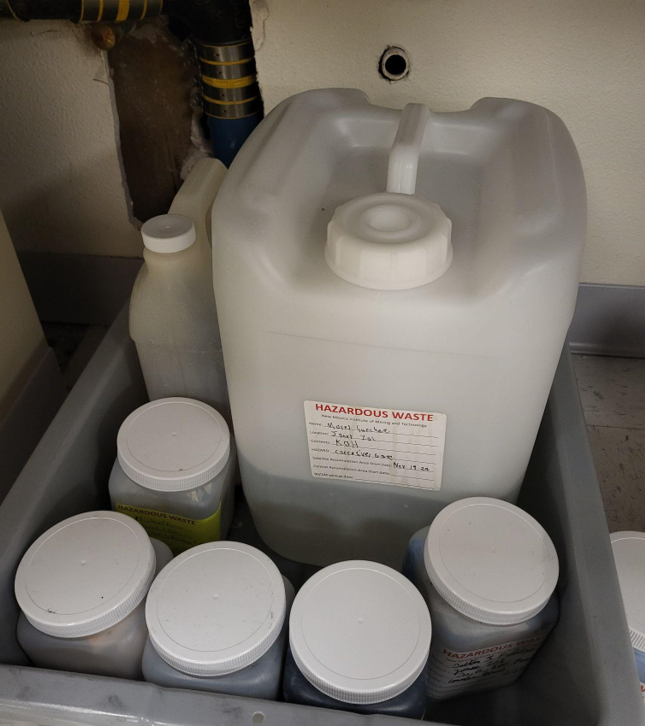 Corrosive (base) containers in secondary containment. This secondary containment is full and awaiting pickup. Several of the smaller containers hold solid waste- potentially contaminated gloves, weighboats and other such materials. Source: Seth Price
Consider the situation where all waste chemicals are stored on a shelf —acids, bases, flammables, oxidizers, etc. Then, there is a minor earthquake and all of the glass bottles fall onto the floor. Bad things happen. Therefore, it is important to separate chemicals by their storage classifications. Typically, these are organic acids, inorganic acids, bases, flammables, oxidizers and a few other specialty categories, such as water-reactive chemicals. In general, acids and bases should be stored as far apart as possible, as should oxidizers and flammables.
Chemical waste containers should have a secondary containment device. Secondary containment can be shared among similar containers. A secondary container may have multiple containers in it, provided they are all flammables, as an example. However, containers should never be stacked on top of one another.
Labeling
All chemicals, including waste chemicals, must be stored in labeled containers. A good chemical label is the factory label, plus a piece of tape that says when the container was opened. For waste containers, most chemical pickup organizations will provide a label or specify what needs to be included.
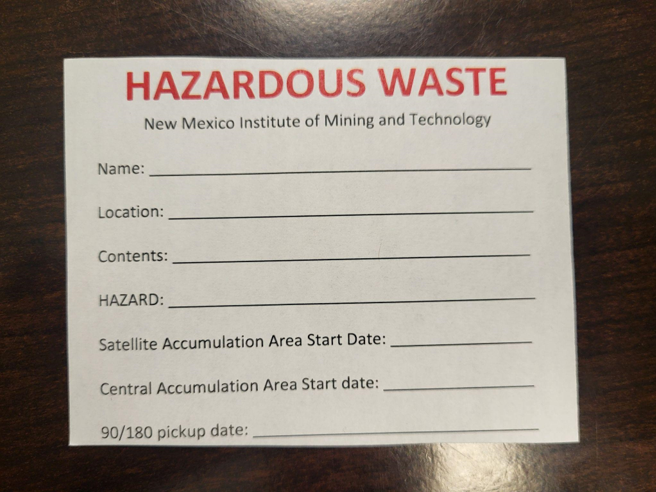 An example waste label from New Mexico Tech. The central and 90/180 pickup dates are filled out by the folks that do the chemical pickup. Source: Seth Price
At a bare minimum, a waste container label must contain the chemical name (a formula does not typically suffice), the date the waste container started, a point of contact and the primary hazard. Depending on the facility, the label might also specify the location.
Final thoughts
Learning the best practices in chemical storage is only a starting point. Technicians and engineers should carefully consider whether a chemical is required before purchasing it. Then, they should consider the entire life cycle, cradle-to-grave, including safe handling and storage of these chemicals. Furthermore, federal, state and local regulations are constantly changing, and so the latest information should always be sought after when new chemicals are purchased or old ones near the end of their lives.