
NIST tests high-tech 'sniffing' device
Marie Donlon | September 12, 2019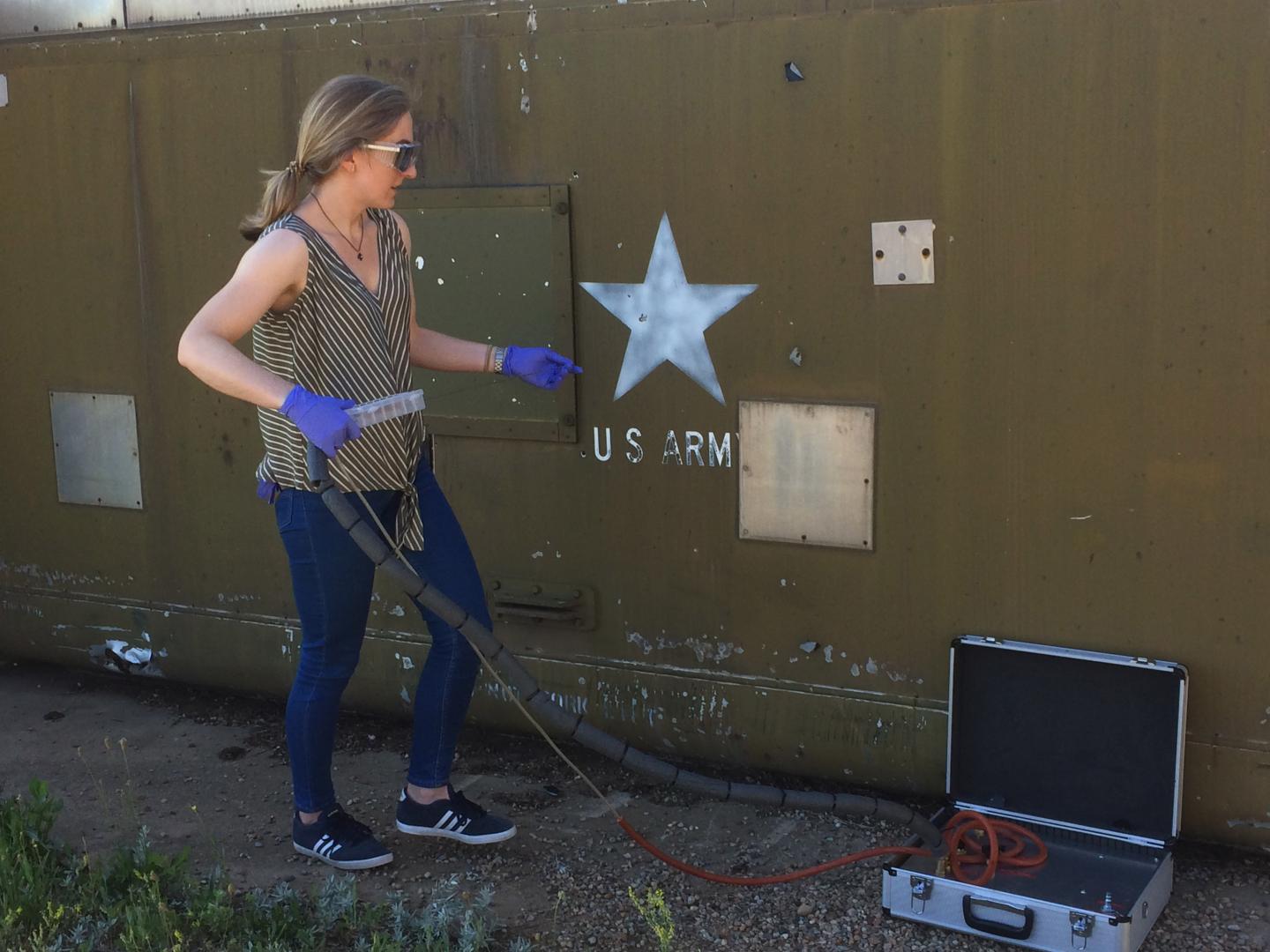 NIST chemist Megan Harries tests whether a portable, high-tech sniffing device called a PLOT-cryo system can be used to screen shipping containers for dangerous airborne chemicals at ports of entry. For this test, which was performed at the NIST campus in Boulder, Colo., Harries used an old US Army communications bunker as a stand-in for a shipping container. Source: Megan HarriesA team from the National Institute of Standards and Technology is testing a high-tech sniffing device that has demonstrated potential for detecting extremely low chemical concentrations in the atmosphere.
The PLOT-cryo device — which is short for "porous layer open tubular cryogenic adsorption" — was first developed in 2007. It is a sophisticated air sampler that operates by taking, or sucking, in air and forcing it through thin, chilled capillary-like tubes that are coated with a material capable of trapping chemicals. Once captured, the user removes the traps and the sample is analyzed in a laboratory using standard lab equipment. This is possible because the PLOT-cryo concentrates the airborne chemicals, making their identification and detection easier. In lieu of that step, analysis of the samples would prove challenging and expensive.
To determine if the device could be used at ports of entry for the purpose of screening shipping containers for illegal and dangerous cargo, NIST chemist Megan Harries tested the device on chemicals concealed in a simulated shipping container. During testing, a portable version of the PLOT-cryo system was used to measure drops of putrescine and cadaverine (chemicals responsible for the horrific odor of rotting corpses) held in glass vials. The vials were then placed on the floor of the simulated shipping container and the doors of the simulated shipping container were left closed for an entire day.
Once Harries returned to the shipping container after the chemicals diffused, she inserted the flexible tube of the device into a drilled hole on the side of the shipping container and determined that it took the device less than a minute to detect the chemicals. Harries conducted additional testing, investigating how other factors such as length of time, temperature and humidity influence how well the device detected chemicals in the air. Harries discovered that in colder temperatures, the device would take longer to detect chemicals in the air.
Likewise, Harries also tested the device on substances thought to be associated with explosives, and other chemicals. As such, Harries believes that after additional modifications, the device may one day improve both public health and safety.
"It was good at detecting some very hard-to-detect stuff," Harries said. "We're close to solving an important problem."
The results of the test appear in the journal Forensic Chemistry.

Not a comms bunker, but a comms shelter for something like an old AN/TTC-39. Essentially is it an insulated aluminum shipping container mounted to a deuce and a half or a 5-ton.