Rice University engineers create storage for keeping nanosurfaces clean
Marie Donlon | July 18, 2023Engineers at Rice University have developed containers that reportedly keep volatile organic compounds (VOCs) — gases that are emitted into the air from assorted products or processes and can be harmful and even cancer causing — from accumulating on the surfaces of stored nanomaterials.
The newly developed storage containers are both portable and inexpensive tech designed for nanomanufacturing and materials sciences labs, according to the Rice University team.
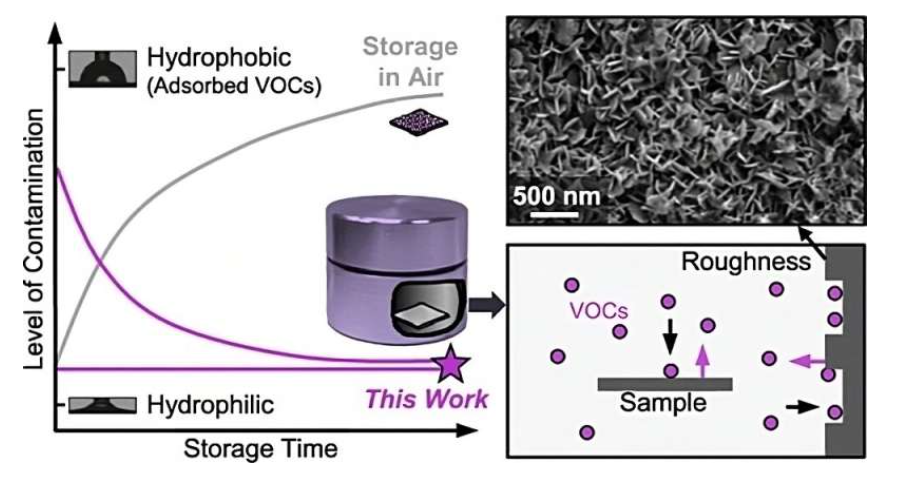 Graphical abstract. Source: Nano Letters (2023). DOI: 10.1021/acs.nanolett.3c00626
Because VOCs are virtually everywhere, emitting from products like paint and cleaning fluids, for instance, and often forming carbon-based coatings indistinguishable to the naked eye on various surfaces — potentially hindering industrial nanofabrication processes, limiting the accuracy of microfluidic testing kits and affecting outcomes on surface research — the Rice University team developed new containers for keeping objects clean.
To prevent VOCs from accumulating on objects for at least six weeks and even cleaning already VOC-contaminated objects, these storage containers feature an ultraclean interior wall enhanced with tiny bumps and divots that range in size from a few millionths to a few billionths of a meter. According to the researchers, these microscopic and nanoscopic bumps and divots increase the surface area of the wall, thereby making more of its metal atoms available to VOCs in the air within the containers when sealed.
"The texturing allows the internal container wall to act as a 'sacrificial' material," the researchers explained. "VOCs are pulled onto the surface of the container wall, which allows other objects stored inside to remain clean."
The new storage containers are detailed in the article “Mitigating Contamination with Nanostructure-Enabled Ultraclean Storage," which appears in the journal Nano Letters.