AI Scientist autonomously conducts scientific research
Marie Donlon | September 04, 2024Researchers at Sakana AI, in Japan, the University of Oxford and the University of British Columbia, have jointly created an artificial intelligence (AI) system capable of autonomously conducting scientific research.
The system, dubbed "The AI Scientist" is reportedly capable of automating the long and involved process of scientific research, which typically starts with a simple idea and subsequently leads to actual research and the writing of a research paper detailing the process used as well as the findings.
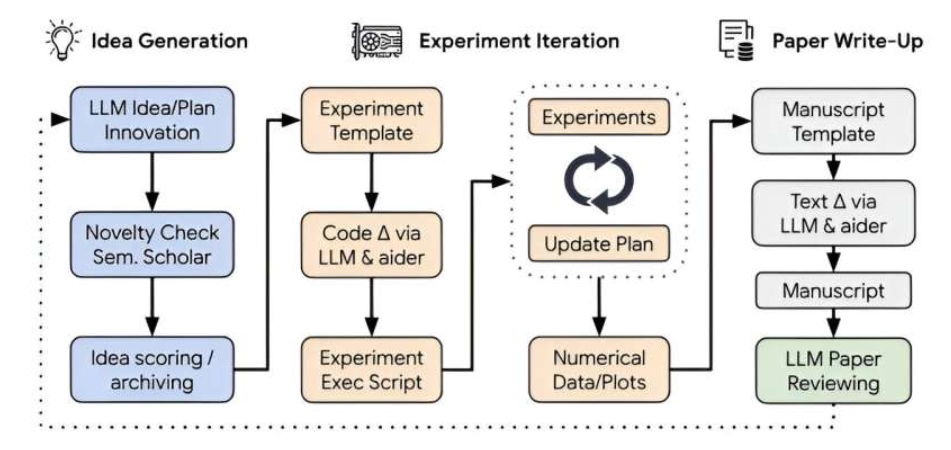 Conceptual illustration of The AI Scientist, an end-to-end LLM-driven scientific discovery process. Source: arXiv (2024). DOI: 10.48550/arxiv.2408.06292
While the process can tend to be long, difficult and generally expensive, the team automated the entire process, thereby eliminating the manpower costs associated with scientific research — from the generation of ideas to the delivery of the written research paper.
To accomplish this, the AI system used large language models (LLMs) to automate the scientific research process. Its developers suggest that the system is already carrying out tasks related to AI research as well as producing acceptance-level research papers.
The team suggests that such research could lead to potential breakthroughs in areas like cancer research, drug development or climate mitigation strategies for instance.
The research is detailed in the article, “The AI Scientist: Towards Fully Automated Open-Ended Scientific Discovery,” which appears in the journal arXiv.