AI tool promises to predict fatal heart rhythm
Marie Donlon | March 29, 2024A new study conducted by a team of researchers from the University of Leicester reveals that artificial intelligence (AI) can be used to predict if a person is at risk of a lethal heart rhythm, with its AI tool correctly identifying the condition roughly 80% of the time.
The condition, dubbed ventricular arrhythmia (VA) is a disturbance in the heart rhythm that originates from the heart’s bottom chambers (ventricles) where the heart beats so rapidly that blood pressure drops, potentially leading to loss of consciousness and sudden death if not immediately treated.
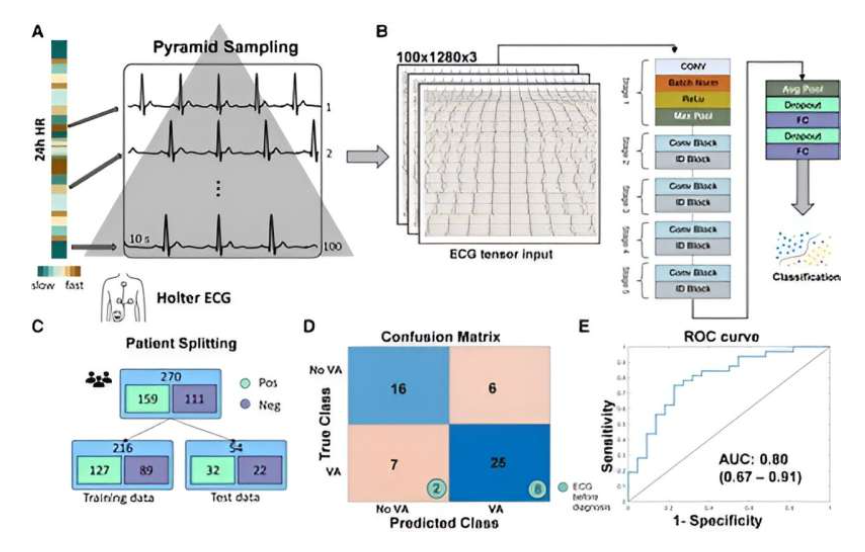 (A) A pyramid sampling schematic demonstrating 100 samples at various heart rates over a 24 h period. (B) VA-ResNet-50 architecture. (C) Patient flow. (D) Confusion matrix including participants before and after electrocardiogram. (E) Receiver operator characteristic curve. Source: European Heart Journal — Digital Health (2024). DOI: 10.1093/ehjdh/ztae004
To develop technology capable of predicting a patient’s risk of developing this condition, the AI tool, dubbed VA-ResNet-50, examined Holter electrocardiograms (ECGs) of 270 patients under medical care between 2014 and 2022, which were captured while the patients were performing everyday tasks at home.
With the outcomes of these patients known — notably, 159 of the patients experienced lethal ventricular arrhythmias 1.6 years, on average, following the ECG — VA-ResNet-50 retrospectively examined the data surrounding 'normal for patient' heart rhythms to determine if their heart was capable of developing lethal arrythmias.
The researchers explained: "Current clinical guidelines that help us to decide which patients are most at risk of going on to experience ventricular arrhythmia, and who would most benefit from the life-saving treatment with an implantable cardioverter defibrillator are insufficiently accurate, leading to a significant number of deaths from the condition. Ventricular arrhythmia is rare relative to the population it can affect, and in this study we collated the largest Holter ECG dataset associated with longer term VA outcomes.”
During tests of the AI tool, researchers determined that VA-ResNet-correctly predicted which patient's heart was capable of ventricular arrhythmia in four out of every five cases. The team added that if the VA-ResNet-50 determined a person was at risk, the risk of such a lethal event was roughly three times higher than normal adults.
The AI tool is detailed in the article, “Artificial intelligence for ventricular arrhythmia capability using ambulatory electrocardiograms,” which appears in the journal European Heart Journal — Digital Health.