Cockroach Robots as First Responders
By Engineering360 News Desk | February 24, 2016American cockroaches' ability to quickly penetrate the tightest joints and seams has inspired the development of a robot that can rapidly squeeze through cracks—potentially providing a new capability for search-and-rescue teams operating in rubble resulting from tornados, earthquakes and explosions.
“What’s impressive about these cockroaches is that they can run as fast through a quarter-inch gap as a half-inch gap, by reorienting their legs completely out to the side,” says Kaushik Jayaram, a postdoctoral fellow at Harvard University who led research into the robot's development while earning his PhD at the University of California at Berkeley. “They’re about half an inch tall when they run freely, but can squish their bodies to one-tenth of an inch—the height of two stacked pennies.”
Using a high-speed camera, Jayaram filmed roaches running at nearly full speed between plates spaced a quarter-inch apart, less than the thinnest part of a roach’s body. While squashed, they cannot properly use their feet, so they use the sensory spines on their tibia to push against the floor to move forward.
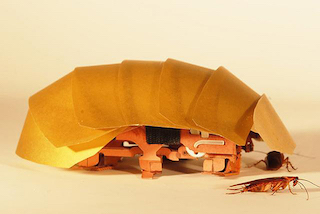 CRAM is able to squeeze into and run through crevices half its height. Image credit: Tom Libby/Kaushik Jayaram/Pauline Jennings/PolyPEDAL Lab, UC Berkeley.“They have to use different body parts to move in these spaces, because their legs and feet are not oriented to work properly,” Jayaram says. “But they are still capable of generating the large forces necessary for locomotion, which blew my mind.”
Jayaram attached sandpaper to the top and bottom of crevices to determine how friction affected their ability to move and found that a smooth top shell and not too much floor friction were keys, since the roach requires sufficient friction to push forward, but not too much to slow it down.
Using the roach technique as inspiration, Jayaram designed a simple and inexpensive palm-sized robot that can splay its legs outward when squashed, then capped it with a plastic shield similar to the tough, smooth wings covering the back of a cockroach. Called CRAM—for "compressible robot with articulated mechanisms"—the device was able to squeeze into and run through crevices half its height.
“In the event of an earthquake, first responders need to know if an area of rubble is stable and safe, but the challenge is, most robots can’t get into rubble,” says Robert Full, professor of integrative biology at UC Berkeley. “But if there are lots of cracks and vents and conduits, you can imagine just throwing a swarm of these robots in to locate survivors and safe entry points for first responders.”
Jayaram built the model robot using an origami-like manufacturing technique that is now available as an inexpensive kit made by Dash Robotics—a commercial spin-off from previous robotic work at UC Berkeley. Now, more robust versions will be needed for real-world testing.
“This is only a prototype, but it shows the feasibility of a new direction using what we think are the most effective models for soft robots, that is, animals with exoskeletons,” Full says. “Insects are the most successful animals on earth. Because they intrude nearly everywhere, we should look to them for inspiration as to how to make a robot that can do the same.”