"Bone bandage" created by KAIST team
Marie Donlon | February 09, 2024Researchers from the Korea Advanced Institute of Science & Technology (KAIST) have developed a piezoelectric material that encourages the growth of bone tissue, which is a typically complex process.
The KAIST team reportedly created a biomimetic scaffold that produces electrical signals once pressure is applied using the unique osteogenic ability of hydroxyapatite (HAp), which is a calcium phosphate material in bones and teeth. According to the researchers, HAp is commonly used in toothpaste as it is a known biocompatible mineral substance that reportedly prevents tooth decay.
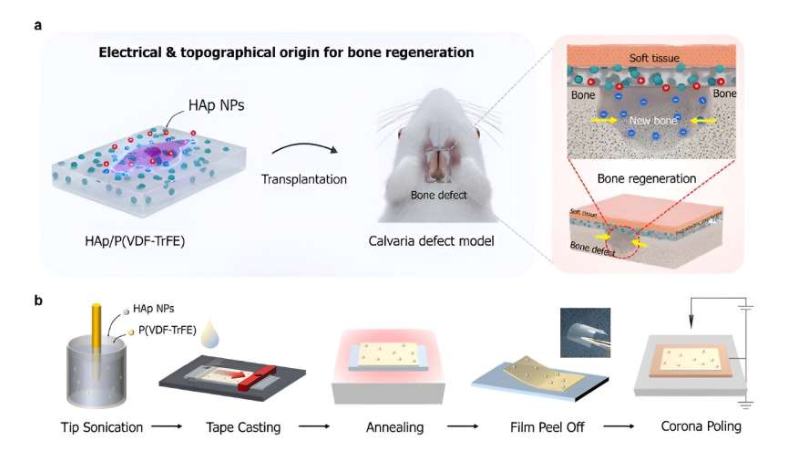 Design and characterization of piezoelectrically and topographically originated biomimetic scaffolds. (a) Schematic representation of the enhanced bone regeneration mechanism through electrical and topographical cues provided by HAp-incorporated P(VDF-TrFE) scaffolds. (b) Schematic diagram of the fabrication process. Source: The Korea Advanced Institute of Science and Technology (KAIST)
While earlier studies on piezoelectric scaffolds revealed that piezoelectricity promotes bone regeneration and improves bone fusion in assorted polymer-based materials, the team struggled to simulate the cellular environment necessary for optimal bone tissue regeneration. A new method was devised that relies on the osteogenic abilities of HAp to create a material that replicates the environment for bone tissue in a living body.
To accomplish this, a manufacturing process was developed that combines HAp with a polymer film. Further, the team demonstrated via in-vitro and in-vivo experiments in rats that the flexible and free-standing scaffold developed through this process showed potential for encouraging bone regeneration.
The researchers explained, "We have developed a HAp-based piezoelectric composite material that can act like a 'bone bandage' through its ability to accelerate bone regeneration." The team added, "This research not only suggests a new direction for designing biomaterials, but is also significant in having explored the effects of piezoelectricity and surface properties on bone regeneration."
An article detailing the team’s findings, “Piezoelectrically and Topographically Engineered Scaffolds for Accelerating Bone Regeneration,” appears in the journal ACS Applied Materials & Interfaces.