AI model predicts COVID-19 variant waves
Marie Donlon | January 03, 2024Researchers from Massachusetts Institute of Technology (MIT) have developed an artificial intelligence (AI) model capable of predicting which SARS-CoV-2 variants are most likely to cause new waves of infection.
Because existing AI models currently being used to make predictions about the dynamics of viral transmission do not predict variant-specific transmissions, the researchers examined what factors might influence the viral spread according to an analysis of about 9 million SARS-CoV-2 genetic sequences gathered by the Global Initiative on Sharing Avian Influenza Data (GISAID) from 30 countries, in combination with data about vaccination rates, infection rates and other factors.
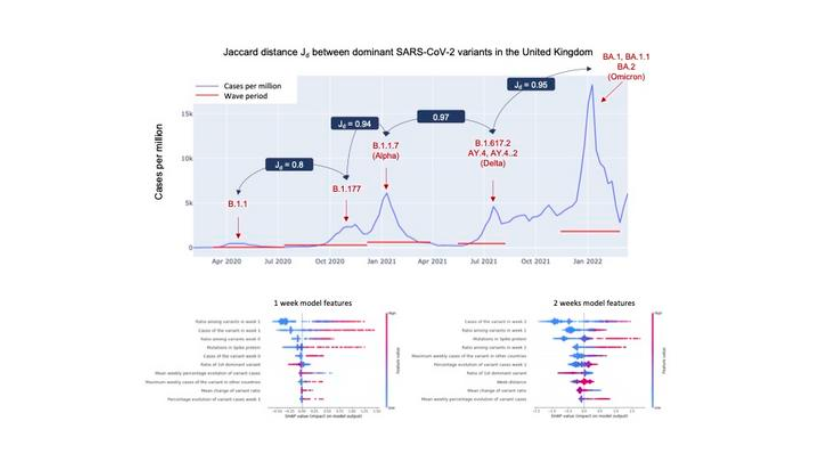 Jaccard distance Jd between dominant SARS-CoV-2 variants in the United Kingdom. Source: Levi et. al.
The patterns revealed by the analysis were used to create the machine-learning powered risk assessment model. According to the researchers, the AI model is capable of detecting roughly 73% of the variants in each country that will cause about 1,000 cases per million people in the next three months, following an observation period of just a week after detection. Further, the predictive performance improved to just over 80% after two weeks of observation.
According to the researchers, the strongest predictors suggesting that a variant will become infectious include: the early trajectory of the infections caused by the variant; the variant’s spike mutations; and the difference in the mutations of a new variant versus those of the most dominant variant while under observation.
The MIT team suggests that the AI modeling approach might be enhanced so that it could make predictions about the future course of other infectious diseases.
An article detailing the AI model, "Predicting the spread of SARS-CoV-2 variants: An artificial intelligence enabled early detection," appears in the journal PNAS Nexus.