Access wind resource data for US wind power systems
S. Himmelstein | January 16, 2024Accuracy in forecasting wind energy resources and trends improves with the availability of a data repository that contains hourly wind speed and generation estimates for existing wind plants located within the contiguous U.S.
The publicly accessible PLUSWIND data base developed by U.S. Lawrence Berkeley National Laboratory researchers provides data for the 2018 to 2021 period and contains three separate estimates of wind speed and generation based on three commonly used meteorological models: MERRA2, ERA5 and HRRR. Access to hourly wind speed and estimated generation data will enable users to evaluate modeling strategies and examine trends in power system availability.
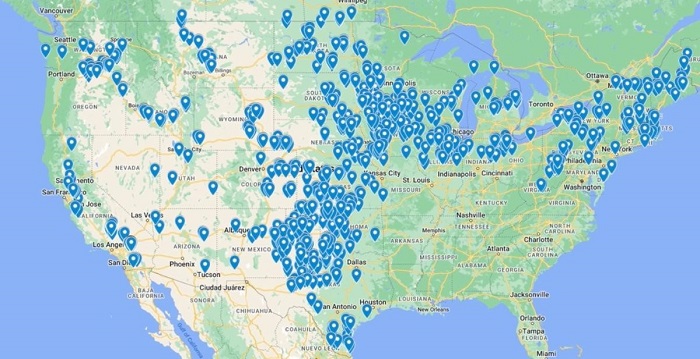 Wind plants included in the PLUSWIND data repository. Source: Scientific Data v10, n883 (2023)
In a study published in Scientific Data, the researchers compared generation estimates to recorded wind generation data across many regions, revealing that accuracy varies widely at the individual plant level but is improved when aggregated to a regional level. When applied to data for the Electric Reliability Council of Texas, the Midcontinent Independent System Operator, the PJM regional transmission operator for the mid-Atlantic region and the Southwest Power Pool regions, the HRRR and MERRA2 models are characterized by relatively small annual biases in the median case while the ERA5 model has a consistently low bias. All models have larger biases in other regions that have more complex topology, such as in California and the Northeast.