Seawater Plume Transmits RF Waves, Receives Digital TV
Engineering360 News Desk | February 12, 2016Mitsubishi Electric Corp. has devised an antenna system that sprays a column of seawater into the air to create a conductive plume for the transmission and reception of radio-frequency waves. While the U.S. Navy has experimented with similar technology, Mitsubishi claims its SeaAerial is the first such device capable of receiving digital terrestrial broadcasts for normal viewing.
The project is part of the company's effort to develop antennas that offer new functions and superior performance, which is focusing on investigating conductive and transmutative liquids as new antenna materials. A plume of seawater can be used as an antenna if it is insulated, so Mitsubishi developed a nozzle that transmits radio waves to the antenna even when the plume is physically connected to the sea surface. Effective insulation is achieved with a quarter-wavelength tube in the nozzle.
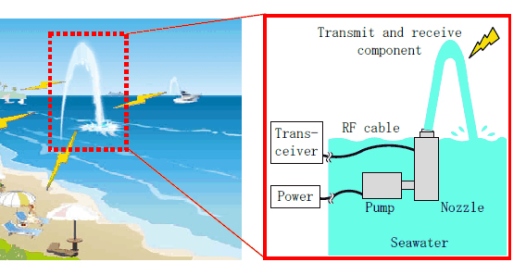 The Mitsubishi-developed antenna is one of the first such device capable of receiving digital terrestrial broadcasts. One challenge was to secure antenna efficiency, or the ratio of radiated power to input power, because seawater is less conductive than metal. The company used simulations to determine the plume’s ideal diameter, resulting in an efficiency of 70 percent, which Mitsubishi says is sufficient for transmitting and receiving signals.
Antenna size is usually determined by its operating frequency, so the height of a low-frequency antenna can be up to tens of meters in some cases. This often requires a complicated configuration and a large structure for support. Finding a fixed place to erect such a large antenna, as well as moving it to another location, can present problems.
SeaAerial, by contrast, can be installed virtually anywhere along the shore, as well as offshore, and can be moved by ship and other vessels because it requires just a pump and an insulated nozzle.