Researchers create record-setting, underwater-sound pressure levels
S. Himmelstein | May 22, 2019Record-level sound pressures exceeding 270 decibels have been generated underwater in research conducted by a team from Rutgers University, Paul Scherrer Institute (Switzerland) and the U.S. 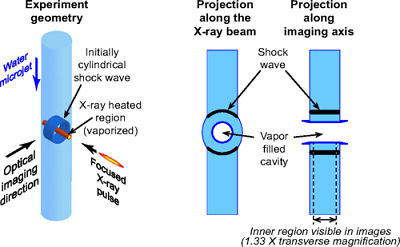 Experiment schematic. A water microjet is intercepted by a focused x-ray laser pulse that launches an initially cylindrical shock wave in the liquid. To observe the propagation of shock and pressure waves, the jet is imaged orthogonal to the jet and the x-ray pulse. Source: G. Blaj et al.Department of Energy’s SLAC National Accelerator Laboratory. For context, normal conversation is measured at 60 decibels, and pain or ear injury can be incurred if exposed to 140 decibels.
The Linac Coherent Light Source at the SLAC facility blasted tiny jets of water with short pulses of X-rays. As the X-ray laser hit the jet, the water vaporized and produced a shockwave that traveled through the jet and replicated itself, forming a shockwave train that alternated between high and low pressures. Once the intensity of underwater sound crosses a certain threshold, the water breaks apart into small, vapor-filled bubbles that immediately collapse. The amplitudes of the pressure waves are estimated to exceed the largest peak-to-peak pressures obtained with focused ultrasonic waves and may be the highest intensity sounds generated to date in liquid water.
The wave mechanism could be used to induce and analyze at atomic resolution the picosecond and nanosecond dynamics of shock damage and tensile failure in soft materials embedded in liquids. The study published in Physical Review Fluids could advance research in biology and materials science, leading to more effective drugs and materials.