Shape-changing robotic microfliers eyed for environmental data collection
Marie Donlon | October 15, 2023A tiny, lightweight robotic device designed for collecting environmental data and conducting atmospheric surveys has been developed by engineers at the University of Washington.
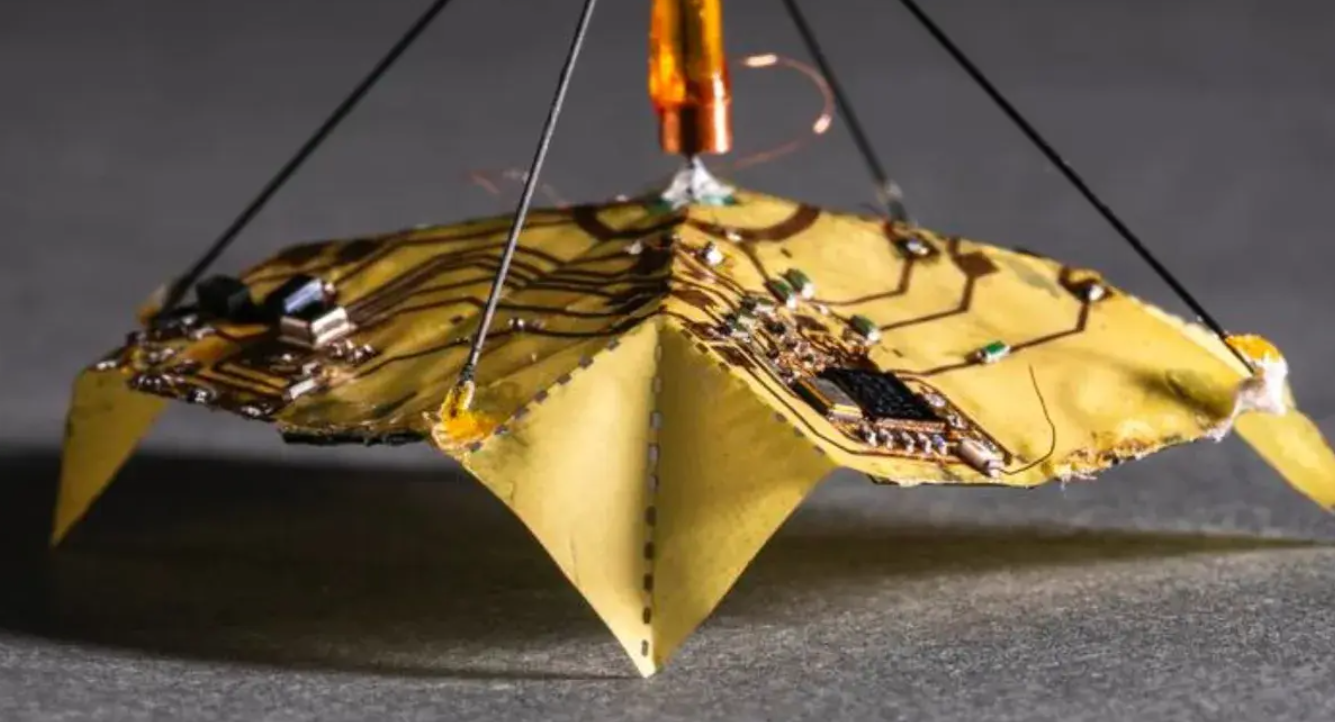
Dubbed microfliers, these tiny robotic devices reportedly glide in mid-air once released from a drone, where they can change shape.
 Source: University of Washington
Inspired by origami, the microfliers, which weigh around 400 milligrams, can reportedly float roughly 131 ft above the ground.
According to its developers, the microfliers each feature a battery-free actuator, a solar power-harvesting system and a controller that initiates shape changes mid-flight.
The University of Washington engineers explained that shape changes can occur dynamically mid-flight as robotic devices spread and descend once released from drones, with the electromagnetic actuators within the robotic devices facilitating the shape transformation — from flat to creased.
"Using origami opens up a new design space for microfliers. We combine the Miura-ori fold [origami], which is inspired by geometric patterns found in leaves, with power harvesting and tiny actuators to allow our fliers to mimic the flight of different leaf types in mid-air,” explained the engineers, in an official release from the University of Washington.
“In its unfolded flat state, our origami structure tumbles chaotically in the wind, similar to an elm leaf. But switching to the folded state changes the airflow around it and enables a stable descent, similar to how a maple leaf falls. This highly energy efficient method allows us to have battery-free control over microflier descent, which was not possible before,” the researchers added.
An article detailing the mircrofliers, “Solar-powered shape-changing origami microfliers,” appears in the journal Science Robotics.