Chemical "Fingerprint" Identifies Bogus Spanish Spice
By Engineering360 News Desk | February 09, 2016Scientists from the Czech Republic and Spain have used chemical "fingerprint" analysis to confirm that much of what is labeled as Spain-originated saffron comes from other countries.
The crimson stigma of the saffron flower (Crocus sativus) is one of the oldest and most expensive spices in the world, particularly those varieties that are recognized for their quality, such as saffron grown in Spain. This has led to the fraudulent labeling of non-Spanish saffron.
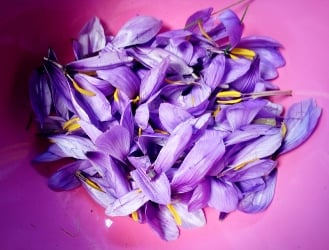 The crimson stigma of the saffron flower is one of the most expensive spices in the world. Image credit: Pixabay. "Over the past few years, the media have been reporting this fraudulent activity, but up until now there were barely any analytical tools that could be used to detect said fraud," says Josep Rubert, a researcher at UCT Prague and the University of Valencia. "So, we created a new strategy to determine the authenticity of saffron based on metabolomics."
Researchers led by Professor Jana Hajslova of UCT Prague developed a classifying methodology that allowed for three types of saffron to be defined: one that is certified with the protected designation of origin (PDO) from La Mancha or Aragon, a second that is grown and packaged in Spain (although it does not have the PDO certificate) and a third category that is packaged as "Spanish saffron" but is of unknown origin.
The first phase of the study consisted of identifying the metabolites, or small-molecule characteristics, of saffron. Subsequently, a method was created to detect these molecules using liquid chromatography coupled with high-resolution mass spectrometry.
The authors suggest that glycerophospholipids and their oxidized lipids are the best molecular markers for determining the origin of saffron. They observed that the saffron technology and processing play a crucial role specifically during the drying process, wherein transformation of the product is determined by the temperature at which the process is carried out.
For saffron originating from La Mancha, for example, the drying process involves laying out the fresh stigmas over sieves that are placed next to a heat source such as a fire, hot coal, stove or brazier. Saffron dehydration happens quickly—approximately half an hour—and is carried out at a temperature of 70 degrees Celsius, which accelerates lipid oxidation.
Their analysis revealed that 26 of 44 samples available commercially and labeled as "Spanish saffron" were neither grown nor processed in Spain.
"It is highly likely that lower-quality saffron is purchased in other countries at a much lower price than in Spain, to later be packaged and sold as Spanish saffron despite being of unknown origin," says Rubert.
The analysis further revealed that the saffron samples labeled with the PDO certificate from La Mancha and Aragon were grown and processed in Spain.
"Here there was no fraudulent activity," says Rubert. The saffron perfectly matched up with our models—unlike the samples of ‘Spanish saffron’ that had either a completely different chemical fingerprint or a different collection of small molecules."