Emerson revolutionizes pressure relief valves for enhanced performance and reduced emissions
Diana Aoun | August 30, 2023Emerson has released two all-new technologies for the Crosby J-series pressure relief valve (PRV) product line. The first, the Crosby Balanced Diaphragm, eliminates the need for bellows in PRVs, while providing balanced operation against backpressure to lower cost of ownership and enhance performance. The second technology is the Bellows Leak Detection, which can remotely detect bellows ruptures in PRVs, and can reduce and accurately calculate volumetric emissions in real-time.
The most common causes of bellows failures are excessive backpressure and rapid cycling. Ruptured bellows cause fugitive emissions and may prevent valve operation at the designed set pressure, with the added risk of overpressure. The Crosby Balanced Diaphragm can replace bellows in PRV applications to address these and other issues. Its innovative design extends the backpressure limits from 60% to 80% and increases the Kb backpressure correction factor by up to 15%, expanding the application range of spring-loaded PRVs.
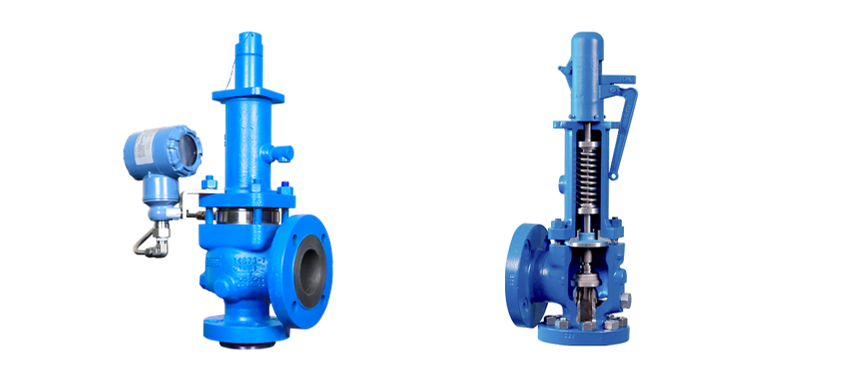 The Crosby J-Series Bellows Leak Detection solution (left) and the Crosby J-Series with Balanced Diaphragm technology (right). Source: Emerson
In addition, diaphragms are inherently more resilient than bellows for higher backpressures and rapid cycling applications. The Crosby Balanced Diaphragm therefore lowers maintenance costs, improves reliability and increases stability.
The Bellows Leak Detection addresses the problem of bellows failures, which are difficult to detect and often remain unnoticed until removal of the valve for periodic service. Leak detection and repair (LDAR) programs may include PRVs, but their target sources for leakage detection are flanges or valve seats, so bellows ruptures will generate fugitive emissions through the PRV bonnet vent that may not be in the LDAR scope.
The Bellows Leak Detection solution is a safer and more efficient method for detecting bellows failures and emissions. It consists of a backup piston and a Rosemount wireless or wired pressure transmitter. The backup piston can reduce emissions by over 90% in the event of a bellows rupture because it has a much smaller clearance than a standard bonnet vent, and it ensures balanced operation. The pressure transmitter provides instant timestamped notification of bellows failure and emissions volume data in real-time.