These CANES support fuel cell durability
S. Himmelstein | September 08, 2023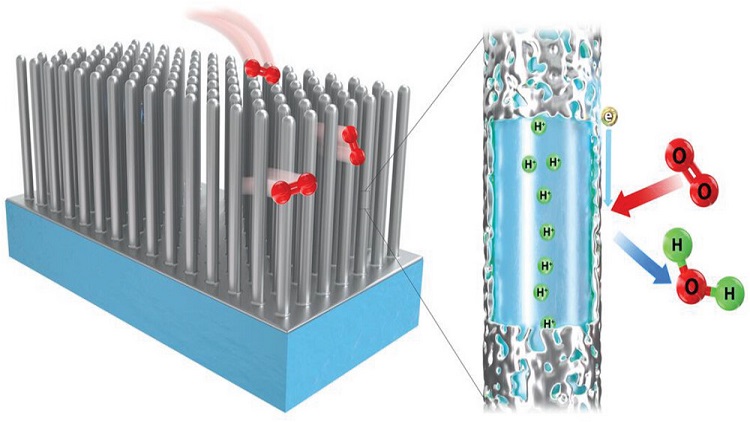 Vertically aligned coaxial nanowires in an electrode with protons transported in the ionomer core inside the nanowire. Electrons transported in the platinum nanofilm shell combine with oxygen to complete the fuel cell cathode reaction. Credit: U.S. Los Alamos National Laboratory
A replacement has been found for the conventional carbon-based catalyst supports that are the culprits of degradation problems and early failure in polymer-electrolyte-membrane fuel cells (PEMFCs). The new component is composed of coaxial nanowire electrodes (CANEs) — vertically aligned arrays of nanowires with functional ion-conducting cores encapsulated by catalytic platinum nanofilms.
Reduced susceptibility to corrosion and the resulting improved durability makes CANE-equipped fuel cells promising candidates for use in heavy-duty trucking applications, which require fuel cell lifetimes of more than 25,000 hours.
PEMFCs incorporating the devices developed by researchers from U.S. Los Alamos National Laboratory, InRedox (Colorado) and U.S. Oak Ridge National Laboratory were subjected to accelerated stress tests to assess their durability. The CANE lost only 2% of its performance after 5,000 stress tests cycles focused on the support materials, compared to an 87% loss in performance observed with a conventional carbon-based electrode.
The new class of catalyst/electrode architecture described in Advanced Materials streamlines proton transport through the ionomer core to realize fuel cell performance levels similar to those of conventional platinum/carbon-based membrane electrode assemblies and without the need for small particles or high electrochemical surface area.