Researchers devise new way to control fire
Marie Donlon | September 15, 2023Researchers from North Carolina State University have created a method that employs a molecule-thin protective layer to control how heat from a flame interacts with material.
Because high-temperature flames are commonly used to create a wide assortment of materials, the North Carolina State University team sought out an approach for better controlling and taming flames used for processing materials.
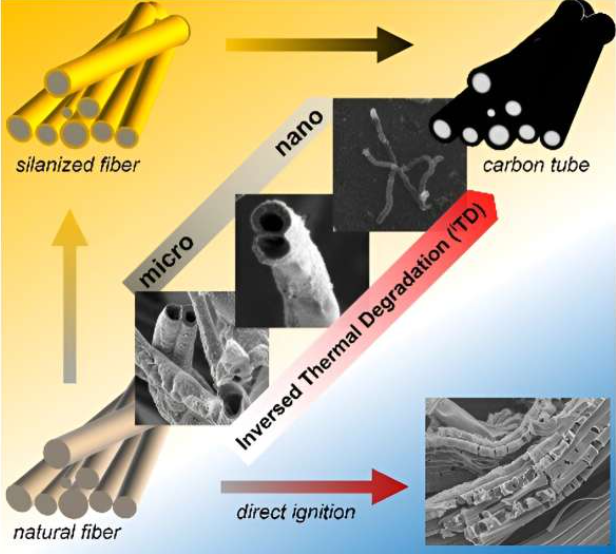 Using morphing surfaces to control ignition and mass transport turns combustion to pyrolysis, hence slows rate of thermal degradation. Pyrolysis leads to incomplete combustion, hence graphitic tubes. This being a surface process, nm to μm wide tubes are produced. Source: Angewandte Chemie International Edition (2023). DOI: 10.1002/anie.202308822
As such, the researchers created a process they call inverse thermal degradation (ITD) wherein a nanoscale thin film is layered over a specific material. According to the researchers, the thin film will change in response to the heat of the fire, and subsequently regulate how much oxygen can reach the material. In other words, the rate at which the material heats up can be controlled, thereby influencing the chemical reactions that occur within the material.
The researchers used cellulose fiber to demonstrate how the ITD process works, explaining that after coating the material with a nanometer-thick layer of molecules and exposing it to a flame, the outer surface of the molecules easily combusts, subsequently increasing the temperature in the immediate surroundings. Meanwhile, the inner surface of the molecular coating is chemically altered, producing an even thinner layer of glass around the cellulose fibers.
This glass layer reportedly limits the amount of oxygen that can reach the fibers, and prevents the cellulose from combusting, causing it to smolder instead.
"Without the ITD's protective layer, applying flame to cellulose fibers would just result in ash,” the researchers explained. "With the ITD's protective layer, you end up with carbon tubes."
The research is detailed in the article “Spatially Directed Pyrolysis via Thermally Morphing Surface Adducts,” which appears in the journal Angewandte Chemie International Edition.