Faster imaging captures combustion flame dynamics
S. Himmelstein | August 16, 2023Data generated by the evaluation of turbulent flame behavior produced during combustion can support the development of more efficient and cleaner combustion systems for cars, airplanes, factories and power plants. Flame dynamics, ignition processes and combustion behavior can now be dissected in detail with a high-speed 3D imaging system developed by researchers in China.
The method detailed in Optica adds high-speed image reconstruction and 3D information to schlieren imaging, a well-established technique for imaging and measuring phenomena in fluids. The new approach can be used to quantitatively obtain the 3D density and velocity distribution of turbulent flames.
A series of fiber bundles is used to transmit light containing flame information from different angles, each of which forms a Toepler's lens-type schlieren system that can image the density variations of the target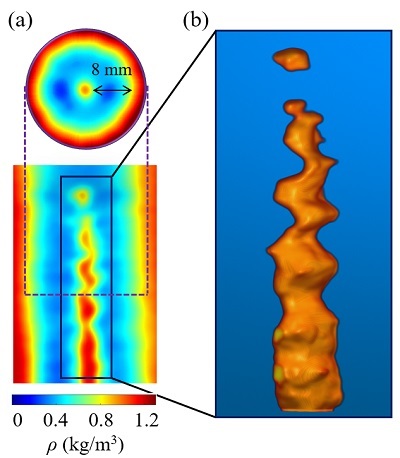 Shown are two cross sections of the 3D density measurement (a) and the 3D iso-surface of the largest density gradient between the mixture and burned product (b). Source: Qingchun Lei, Northwestern Polytechnic University flames. Computed tomography is then used to reconstruct the 3D schlieren images, followed by post-processing of the 3D schlieren images to obtain 3D density and velocity information.
Researchers from Northwestern Polytechnic University and Shanghai Jiao Tong University conducted experiments on turbulent and laminar premixed flames as well as transient ignition processes to assess the performance of the imaging technique. A single high-speed camera, two Xenon lamps and a series of fiber bundles were used; the latter were positioned to capture schlieren images of the flames from seven different orientations simultaneously while the camera recorded the images at a high frame rate.
The high-speed 3D schlieren imaging approach successfully captured and measured the flame dynamics, structure and ignition processes in a relatively affordable experimental setup is relatively compared to reliance on more complex equipment, such as lasers.