Marine Worm Inspires Wet Glue
Engineering360 News Desk | February 05, 2016The adhesion properties of the sandcastle worm, a resident of California’s intertidal zone, have been reproduced by University of California (Santa Barbara) engineers.
The underwater glue has the potential for diverse biomedical and non-biological applications, including tissue repair and dental adhesives. Additionally, industrial and commercial applications that require adhesion in wet environments could benefit from this technology.
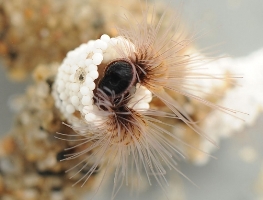 Sandcastle worms serve as inspiration for wet glue. Image credit: Fred Hayes.Sandcastle worms secrete an adhesive to build a tube reef (sandcastle) in harsh intertidal environments where wind and wave velocity often exceed 25 meters per second, says Kollbe Ahn, a research faculty member at UCSB’s Marine Science Institute and co-lead author of a paper in Nature Materials. “We successfully replicated the strong wet-contact adhesion of the bio-adhesion featuring nanoscopic chemical and miroscopic porous structures,”Ahn says.
While wet glues have been the subject of research and development for years, researchers have yet to approach the performance of the natural substances in terms of stickiness and the rapidity with which the adhesion process occurs. Synthetic underwater adhesives have typically required complex processing and functionalization, adding several steps to what ideally would be a simple process.
The sandcastle worm-inspired glue may be noteworthy because, through a phenomenon called solvent exchange, adhesion becomes more streamlined. No pre-immersive dry curing is required, and the resulting microarchitecture makes it more resistant to cracking, researchers say.
“The processing of this wet glue does not need pre-immersive dry curing or applied compressing pressure that are normally required in conventional studies,” Zhao says. The synthetic glue also promotes adhesion between a variety of surfaces, including plastics, glasses, metals, wood and biological tissues.
Additionally, the resulting microarchitecture of the synthetic glue, which mimics the porous structure of sandcastle worm adhesive, may make it more resistant to cracking.