Sensor chip speeds disease diagnostics
S. Himmelstein | July 28, 2023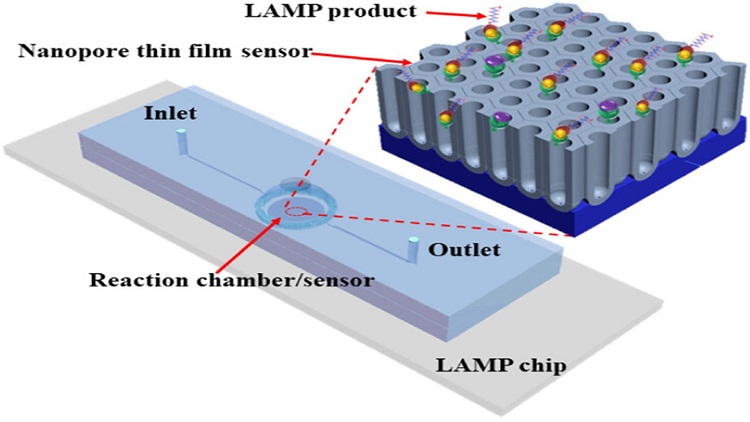 Schematic of the basic configuration of the LAMP reaction chamber and nanopore film sensor containing immobilized LAMP products. Source: Texas A&M University
A faster route to the accurate detection of pathogenic agents shows promise for low-cost point-of-care diagnostics in plants, foods and humans. A low-cost sensor chip designed by researchers from Iowa State University and Texas A&M University enhances the loop-mediated isothermal amplification (LAMP) technology widely used to detect pathogens by amplifying their DNA.
Unlike established LAMP protocols, the new sensor performs without the need for costly fluorescence dyes and other reagents and negates the need for lengthy DNA purification processes that may pose challenges for point-of-care use. The nanopore thin-film sensor chip is housed inside a special reaction chamber where amplified LAMP products are bound by primers formulated to be immobilized on the nanofilm. The resulting signals are directly and easily measured with a portable spectrometer.
A study published in ASC Sensors details application of the sensor to detect Phytophthora infestans, a pathogen responsible for globally devastating late blight disease of some food crops. The chip documented concentrations as low as 1 femtogram/μL of the target pathogen’s DNA in 30 minutes and proved at least 10 times more sensitive than currently available methods.
Thie sensing technology offers scope for advancing portable platforms to detect pathogens using label-free sensors with ultra sensitivity.