Video: A guide to planning asteroid mining missions
S. Himmelstein | July 03, 2023Near-Earth asteroids (NEAs) pose promising targets for resources to be mined and used for space manufacturing. These celestial bodies may host metals, semiconductors and volatiles to support production of propellant, space construction and life-support of crewed missions. To simplify the search for such extraterrestrial assets, candidate asteroids for future exploitation can be found in a new web-based tool.
The Exploitation des Resources des Corps Celestes (ECOCEL) database developed at the Institut Supérieur de l'Aéronautique et de l'Espace (ISAE-SUPAERO, or the National Higher French Institute of Aeronautics and Space) contains available compositional data and mission logistics for 326 NEAs. For each NEA, the database includes one-way and round-trip rendezvous mission opportunities and trajectories computed for the 2025 to 2050 launch period, and estimated composition inferred from spectral classification and meteorite analogs.
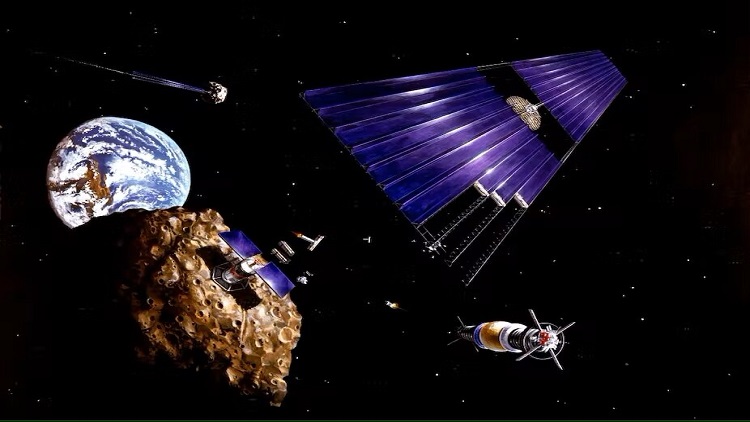 Asteroid mining concept. Source: NASA/Denise Watt
ECOCEL is intended to enable searching for suitable target asteroids while specifying mission constraints. The tool also provides a visualization of compositional data for the entire sample of asteroids.
Tool developers relied on data from the NASA Jet Propulsion Laboratory's Small-Body Database, a publicly available database that tracks almost 25,000 NEAs most likely to be visited by a first asteroid mining mission. To calculate how to reach an object, this database calculates the delta-V — the change in velocity necessary to reach a target. The Small-Body Database features a specially designed interface that can select an asteroid based on minimizing the delta-V for a particular launch window.