
Optimizing PV-battery-electrolyzer-fuel cell energy system design
S. Himmelstein | July 19, 2023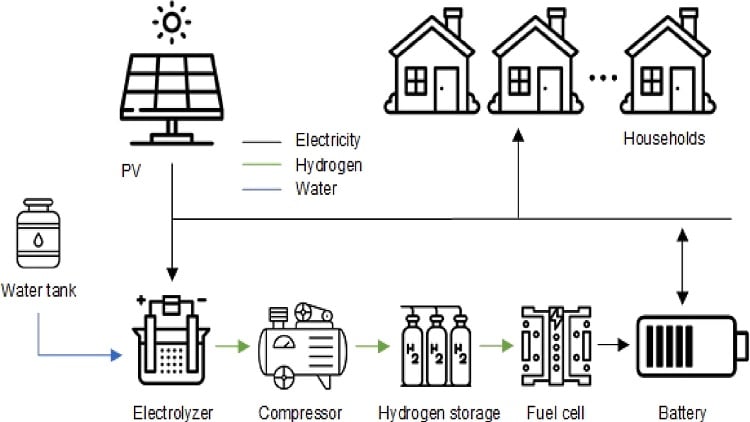 Schematic of an off-grid PV-battery-electrolyzer-fuel cell energy system. Source: Renew Sustain Energy Rev, 181 (2023)
A systematic sizing approach for designing the individual components in a photovoltaic (PV)-battery-electrolyzer-fuel cell energy system has been developed with the goal of achieving self-sufficiency and system sustainability in remote or off-grid locations where access to the grid is limited. The method devised at the Delft University of Technology in the Netherlands is intended for such systems that use the generated hydrogen for long-term energy storage and the battery for short-term storage.
The proposed system configuration powers the electrolyzer with surplus PV power in summer to produce hydrogen, which is then delivered to a compressor, stored in tanks and used for electricity production via the fuel cells in winter. Load demand in winter is met by PV and battery storage, or by hydrogen when PV generation is not available and the state of charge of the battery is below 40%.
The system is sized in a way so that loss of load probability (LLP) — the ratio between the load demand that cannot be met by the energy system in a year divided by the total annual load demand — is always equal to zero. Stability and reliability of the energy system increase with a lower LLP.
Simulations indicated that the system could achieve a levelized cost of energy that is still higher than the energy price in the Netherlands. However, integration of the electrolyzer and the fuel cells with the solar-plus-storage installation enhances reliability and security of the energy supply.
The scientists plan to expand on the research reported in Renewable and Sustainable Energy Reviews to explore alternatives to tanks for hydrogen storage and reduce system costs, and to study the use of heat to meet the heat demand of end-users.

I've been advocating a system like this for some time for the individual home in town or anywhere else. Photons to solar panels to electricity. Electricity to electrolyzer to split the H2O molecule to make H2 and O2 (O2 vented to the air), H2 to the storage tanks, H2 to the fuel cell to put the H20 molecule back together producing electricity for the home (24/7). Excess H2 will be used to fuel your fuel cell car.
Energy independent, HUH? I wish I could get funding to build or retrofit a house like this. Then, we could get some real numbers for cost projections.