Hydrogen Injected Into Gas Pipeline Helps Power Campus
John Simpson | December 14, 2016University of California, Irvine (UCI) engineers have implemented a power-to-gas (P2G) hydrogen pipeline injection project, demonstrating the use of excess clean electricity that would otherwise go to waste.
P2G is a technique for converting surplus energy from solar panels or wind farms into hydrogen, which can be blended with natural gas and utilized in everything from home appliances to power plants. The renewable fuel can also be stored in containment vessels for later use, such as in hydrogen fuel cell vehicles.
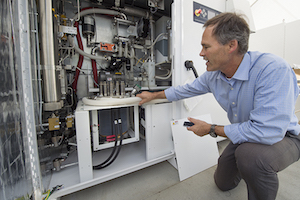 Jack Brouwer, associate director of UCI's Advanced Power and Energy Program, examines an electrolyzer, which uses excess electricity to split water into oxygen and hydrogen. Image credit: Steve Zylius/UCI. “One of the big challenges we’ve faced in adding wind and solar to the grid is what to do with the excess electricity,” says Jack Brouwer, associate director of UCI's Advanced Power and Energy Program (APEP). “We’ve shown you need not halt renewable power generation when demand is low. Instead, the excess electricity can be used to make hydrogen that can be easily integrated into existing natural gas pipeline infrastructure.”
The pilot project began last summer with funding from the Southern California Gas Company and the participation of Proton OnSite, provider of an electrolyzer that produces hydrogen from electricity and water. APEP engineers worked with facilities management technicians to install the new equipment adjacent to the campus’s power plant. Since then, the process has been monitored by researchers to determine whether P2G is feasible for statewide or regional power grids. Such systems are currently in place in Germany and Canada.
“Our initial testing indicates smooth operation for this first successful U.S. proof of concept,” says Brouwer. “Storage of the hydrogen in existing natural gas infrastructure could produce a massive hydrogen battery that could become the most important technology for enabling a 100% renewable future.”
The central component of the process, the electrolyzer, takes in water and uses excess electricity to power an electrochemical reaction that splits it into hydrogen and oxygen. The latter is released into the atmosphere, and the hydrogen is compressed and sent about 60 feet through a pencil-thin, stainless steel tube to an injection point in UCI’s natural gas pipeline. The hydrogen is mixed with natural gas and burned in the gas turbine power plant to generate electricity and heat for the campus.
“This research lays the groundwork for leveraging the natural gas infrastructure already in place for the storage and transmission of renewable energy,” says Jeff Reed, director of business strategy and advanced technology at the Southern California Gas Company.
Brouwer says a team of graduate students will continue monitoring the system and conduct research in related topics—such as the effect of hydrogen transport on natural gas pipelines. They are also looking into methanation, which takes carbon dioxide out of the atmosphere and combines it with hydrogen to create a sustainable fuel.