Economic gains flow from urban stream restoration
S. Himmelstein | May 26, 2023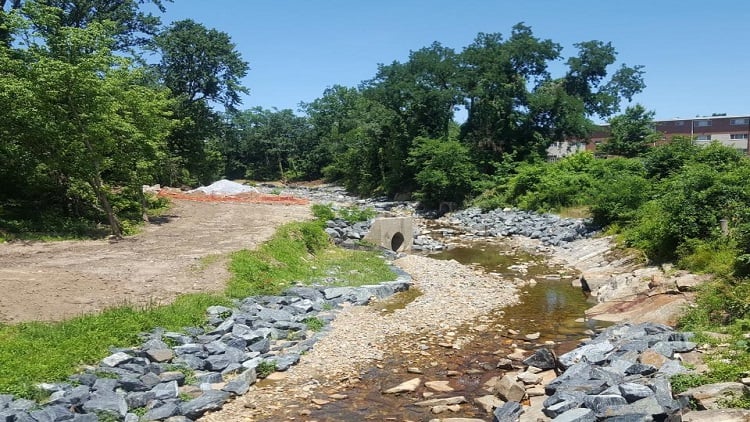 Source: University of Maryland
The restoration and protection of streams impacted by urbanization offers diverse economic benefits that are captured and estimated in an ecological production function framework.
The method draws on existing water quality monitoring data and uses computational modeling to predict water quality changes and use/non-use benefits related to various regulatory interventions. The framework leverages expert assessments of how these water quality changes translate into ecological endpoints valued by the public. Results from a stated preference survey of area residents are then applied to quantify the public's willingness to pay for these outcomes, and, by extension, for improvements in stream water quality.
When applied to data from two counties in the Piedmont region of North Carolina, the analysis revealed that residents of the area containing the Upper Neuse River Basin would be willing to pay an average of $127 per household per year for water quality improvements derived from increasing tree cover along stream banks by 25% and decreasing runoff from impervious surfaces, such as streets.
Initially developed for the Piedmont region of the eastern U.S., the framework outlined in the Proceedings of the National Academy of Sciences could, be extended for evaluation of larger streams and rivers, rural waterbodies, and estuaries and coastal waters across the U.S.
Researchers from North Carolina State University, Visa Inc. (California), University of Minnesota and University of Maryland participated in this study.