Team repurposing facemasks for carbon capture applications
Marie Donlon | March 22, 2023Roughly millions of tons of medical waste — specifically face masks — have accumulated in the years following the emergence of COVID-19, posing an environmental threat. Now, researchers from Newcastle University in Singapore are attempting to divert that waste from the landfill to the lab.
The Newcastle team is converting the single-use facemasks, which contain plastic components, into porous activated carbon fibrous absorbents capable of removing CO2 from the air.
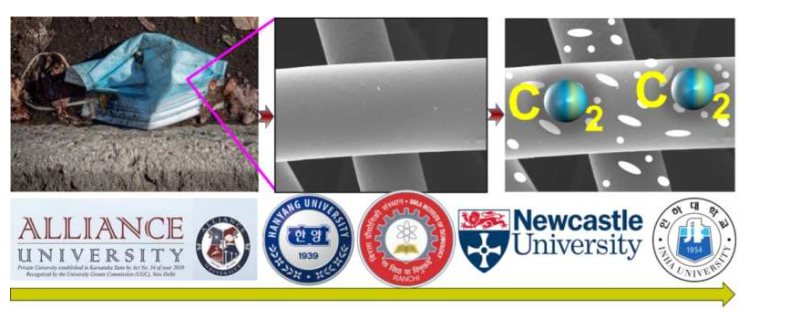 Source: Newcastle University in Singapore
Making these fibrous adsorbents appropriate for such a task is their reported higher adsorption rate and adsorption capacity, the presence of more adsorption sites and ease of handling.
To convert the face masks into porous activated carbon fibrous absorbents, the researchers developed a process for forming a number of pores capable of heavy CO2 adsorption on the surface of developed fibers. To modify the surface of these fibers, the team used amine containing compounds (TEPA), which further amplified CO2 capture and resulted in an adsorbent with a high absorption capacity. Further, the team suggested that the adsorbed CO2 can be regenerated while the adsorbent can be reused several times. Meanwhile, the regenerated CO2 can reportedly be used for green fuel, beverages and dry ice, according to purity.
In addition to carbon capture, the fibrous adsorbents extracted from the recycled facemasks can also be employed for separating various dyes from aqueous solutions with a 94% rate of efficiency. This reported performance suggests that the porous absorbent could also be used in the treatment of polluted wastewater discharged from the textile and leather-making industries.
An article detailing the team’s findings, “A novel approach to fabricate super adsorbents from used face masks for large CO2 capture and dye removal,” appears in the journal Carbon.