Soft robot easily shifts from land to sea
Marie Donlon | March 23, 2023Researchers from Carnegie Mellon University have created soft robots that can transition from walking to swimming and crawling to rolling.
To accomplish this without added complexity or weight, the team constructed a bistable actuator composed of 3D-printed soft rubber featuring shape-memory alloy springs that respond to electrical currents through contracting, thereby causing the actuator to bend. By leveraging this bistable motion, the researchers enabled the actuator, and thus the soft robot, to alter its shape.
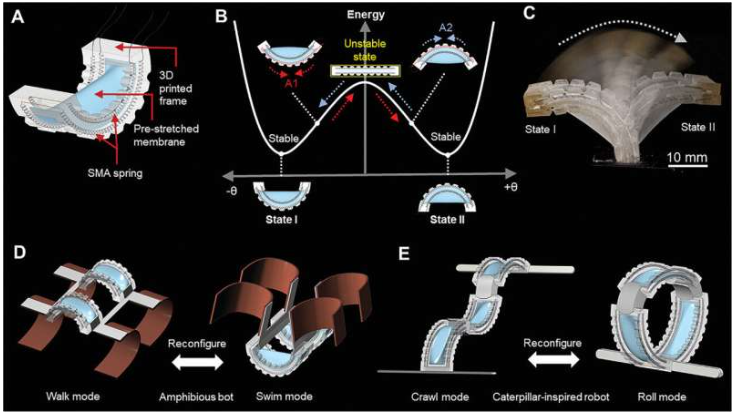 1 / 1A) Schematic view of bistable actuator, B) Transition of bistable actuator from State I to State II and vice-versa with respect to free energy, C) Picture of bistable actuator triggered from state I to state II, Schematic (Rendering image) of reconfigurable multimodal and amphibious soft robots: D) a Amphibious bot and E) a Caterpillar-inspired robot. Source: Advanced Materials Technologies (2022). DOI: 10.1002/admt.202201259
According to the researchers, following an electrically induced shape-change, the robot can return to its previous configuration through the application of another electrical charge.
Among the series of soft robots built by the Carnegie Mellon team is a robot that features four curved actuators located at the corners of a cellphone-sized body composed of two bistable actuators. The researchers explained that the curved actuators act as legs on land, enabling the robot to walk. Meanwhile, submerged in water, the bistable actuators alter the shape of the robot, transforming the curved actuators into propellers for swimming.
"You need to have legs to walk on land, and you need to have a propeller to swim in the water. Building a robot with separate systems designed for each environment adds complexity and weight," the researchers explained. "We use the same system for both environments to create an efficient robot."
In addition to its walking/swimming robot, the team designed two more robots including one that can shift between crawling and jumping and another that can shift between crawling and rolling.
The researchers suggest that these robots could one day be used in rescue missions or in marine applications.
The shape-shifting robots are detailed in the article, Highly Dynamic Bistable Soft Actuator for Reconfigurable Multimodal Soft Robots, which appears in the journal Advanced Materials Technologies.