Wi-Fi Sensing from Cellphones Could Improve Bus Service
Engineering360 News Desk | January 22, 2016University of Washington (UW) researchers have developed a sensor system that collects Wi-Fi and Bluetooth signals from bus riders’ electronic devices to generate a real-time picture of citywide passenger flows that could help transit agencies provide better service. To improve efficiency, agencies typically rely on passenger surveys, head counts and smart card swipes, which may offer only partial information about how people are using the transit network.
The UW transportation engineers have developed sensors—which cost about $60 per bus—that can detect a unique identifier called a media access control (MAC) address associated with a particular mobile device as it enters and leaves a bus. The system collects MAC addresses as well as the time and location they are detected from Bluetooth or Wi-Fi signals. Each address is made anonymous for privacy protection.
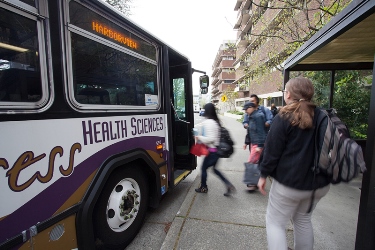 The sensors detect a unique identifier from mobile devices. Image credit: UW.The technology has been used to estimate vehicle travel times on highways and roads, but this is one of the first attempts to investigate its use for collecting passenger origin and destination data on a transit system, the researchers say. The research team, led by Yinhai Wang, UW professor of civil and environmental engineering, tested the system in May 2015. They installed sensors on the South Lake Union Shuttle and Health Sciences Express buses operated by UW Transportation Services.
Because the system only senses addresses from mobile devices that have Wi-Fi enabled or whose Bluetooth is in discoverable mode—which wouldn’t be the case for everyone riding a bus—the transportation engineers needed to determine whether they could collect enough data to yield an accurate picture of travel behavior.
A second challenge was developing processing algorithms to filter out the signals from mobile devices running Wi-Fi or Bluetooth carried by people who are near a bus but are not actually riding on it. “That’s probably the hardest part of the whole thing,” says Kristian Henrickson, a UW civil and environmental engineering doctoral student and research assistant who manages the university's Smart Transportation Application and Research lab.
“The big things we’re concerned with are pedestrians and cyclists or people in cars or buildings [who] have their Wi-Fi and Bluetooth devices on and are close enough to have the sensors on the bus pick up those signals,” he says. “So we have to make sure we filter out those addresses.”
The sensors mounted inside the buses initially picked up more than 20,000 unique mobile device addresses, times of detection and GPS locations during the test period. After weeding out signals that were unreasonably long or short, or that appeared or vanished far from a bus stop, the researchers counted 2,800 “trips” that they say were taken by bus passengers.
The origin and destination data from the remote sensing system matched information that the researchers collected by riding buses and by tracking how many people boarded and disembarked at various stops. “We were able to prove the concept and demonstrate that it’s much cheaper to collect data this way,” says Wang.
One question yet to be answered is whether data collection that relies on Wi-Fi and Bluetooth signals could omit certain segments of the population, such as the elderly or low-income earners, who may not carry mobile devices or use wireless networks. As such, the researchers are interested in investigating how people use different technologies during their commutes.
Given the breadth of cell phone ownership, though, Henrickson says the technology’s potential to improve equity in the transit system likely outweighs potential drawbacks. “Think about understanding how long and disconnected a route may be from some less-privileged neighborhoods to an employment center. This technology provides a much better way of assessing that and possibly improving upon that,” he says.