Lithium-Ion Battery Shuts Down When It Overheats
Engineering360 News Desk | January 21, 2016Stanford University researchers have developed a lithium-ion battery smart enough to shut itself down when it’s too hot, and not restart until optimal cooling has taken place. The new process may ease the potential threat of fire in the batteries, which are known for high energy density and good charging performance in a smaller profile than other rechargeable batteries. In this video, Professor Zhenan Bao explains how the smart l-ion battery shuts itself down with the assistance of a polyethelyne film.
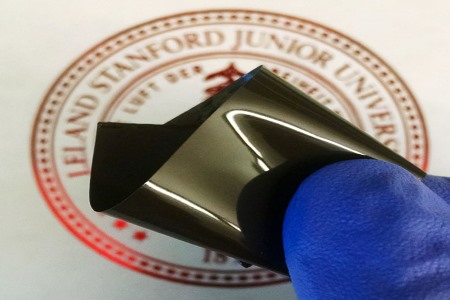 This thin film could keep li-ion batteries from catching fire. Image source: Stanford University The process, developed by Zhenan Bao, professor of chemical engineering, builds on nanotechnology used in producing wearable body sensors that monitor temperature. By incorporating spiked nickel particles coated in graphene into a layer of elastic polyethylene, a film is created, which then is connected to one end of an electrode for current flow. As the particles in the film stay in close proximity, they create conductivity. But, as heat builds, the polymer layer expands, stretches, and reduces contact between the nanoparticles. As the nanoparticles stop touching, conductivity ceases and forces the battery to shut down. Once the film has cooled sufficiently to return to its original size, power is restored.
Tests show the film responds to heat at 160 degrees, quickly expanding and shutting down the battery. When the temperature falls below that temperature, the battery again becomes functional. The researchers say they believe they can tune the film to react at higher or lower temperatures, based on the amount and type of particles that are embedded. Tests reportedly showed consistent repeatability in the process. The researchers believe the film shows great promise for high performance as well as safety.