“Designer Carbon" That Boosts Energy Storage Performance
Engineering360 News Desk | June 16, 2015Scientists from Stanford University have developed a carbon material that they say can greatly improve the performance of energy-storage technologies.
The so-called “designer carbon” marks an improvement over conventional activated carbon, which is a relatively inexpensive method that is commonly used in water filters, air deodorizers and energy storage devices, among other uses.
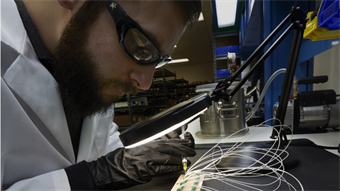
"We have developed a 'designer carbon' that is both versatile and controllable," says Zhenan Bao, the senior author of the study and a professor of chemical engineering at Stanford. "Our study shows that this material has exceptional energy-storage capacity, enabling unprecedented performance in lithium-sulfur batteries and supercapacitors." The designer carbon has exceptional energy-storage capacity, enabling unprecedented performance in lithium-sulfur batteries and supercapacitors. Image credit: John To and Zheng Chen, Stanford University
Low-cost activated carbon is made from coconut shells, which are activated by burning the coconut at high temperatures and then chemically treating it. Through the activation process, nanosized holes or pores are created. These increase the surface area of the carbon and enable it to catalyze more chemical reactions and store more electrical charges.
Bao says there are “serious drawbacks” to activated carbon, however, because there is little interconnectivity between the pores. This limits their ability to transport electricity. "With activated carbon, there's no way to control pore connectivity," says Bao.
Bao and her team found a way to synthesize high-quality carbon using chemicals and polymers. The process starts with conducting hydrogel—a water-based polymer with a spongy texture similar to soft contact lenses.
"Hydrogel polymers form an interconnected, three-dimensional framework that's ideal for conducting electricity," says Bao. "This framework also contains organic molecules and functional atoms, such as nitrogen, which allow us to tune the electronic properties of the carbon."
For the study, the Stanford team used a mild carbonization and activation process to convert the polymer organic frameworks into nanometer-thick sheets of carbon.
"The carbon sheets form a 3D network that has good pore connectivity and high electronic conductivity," says graduate student John To, a co-lead author of the study. "We also added potassium hydroxide to chemically activate the carbon sheets and increase their surface area."
This results in a designer carbon that can be fine-tuned for a variety of applications. For example, raising the processing temperature from 750 degrees Fahrenheit (400 degrees Celsius) to 1,650 F (900 C) resulted in a 10-fold increase in pore volume, the researchers say.
Subsequent processing produced carbon material with a surface area of 4,073 square meters per gram—equivalent to the area of three American football fields per ounce of carbon. The maximum surface area achieved with conventional activated carbon is about 3,000 square meters per gram.