MIT software improves pump and valve designs
Amy J. Born | February 03, 2023Due to their complexity, fluidic devices such as hydraulic pumps, combustion engines and propellers used, for example, to generate power or transport water, are most often developed manually by experienced engineers who design, prototype and test them in an iterative process that is costly, time consuming and labor intensive.
Researchers at MIT have developed a computational pipeline that automatically generates an optimal design based on user objectives. The user simply specifies the location and speed at which fluid enters and exits the device.
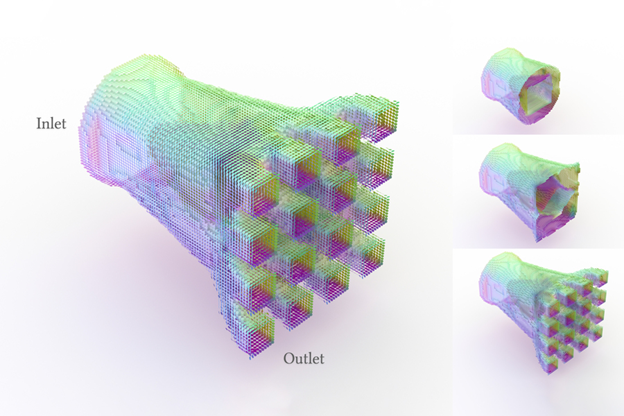 Source: Yifei Li/MIT CSAIL
Recently developed computational tools that have simplified the manual design process have had limitations, such as requiring the device shape to be specified in advance, or relying on representative shapes using 3D cubes, called voxels, that produce a boxy, ineffective design.
The computational technique developed at MIT utilized a design optimization framework that does not require the user to make assumptions about how the device should look. Rather, the shape evolves during the optimization process, allowing for more complex shapes.
“Now you can do all these steps seamlessly in a computational pipeline. And with our system, you could potentially create better devices because you can explore new designs that have never been investigated using manual methods. Maybe there are some shapes that haven’t been explored by experts yet,” says Yifei Li, an electrical engineering and computer science graduate student who is lead author of a paper detailing this system.
The researchers tested their design pipeline against existing parametric optimization frameworks that are considered state of the art yet require designers to specify the device shape in advance. “Once you make that assumption, all you are going to get are variations of the shape within a shape family,” Li says. “But our framework doesn’t need you to make assumptions like that because we have such a high design degrees-of-freedom by representing this domain with many, tiny voxels, each of which can vary its shape.”
The MIT framework outperformed the baselines, and, optimizing nearly 4 million variables, came up with complex forms such as a tree-shaped fluidic diffuser, and a propeller-shaped device that creates a twisting flow of liquid.
The system could lead to fluidic devices for a variety of applications that are designed faster and cheaper. Devices such as microfluidic labs-on-a-chip that use a few drops of blood to diagnose disease or even artificial hearts.