Gyroids May Shape Future of Structural Composites
Chuck Heschmeyer | January 25, 2017Complex geometric shapes called gyroids may eventually shape the future of lightweight structural composites used to make everything from aircraft and automobiles to building materials.
Using 3-D printers and graphene, researchers at the Massachusetts Institute of Technology designed a porous, 3-D form of two-dimensional graphene that can be 10 times stronger than steel but lighter at 5% the density.
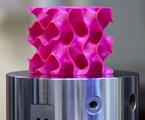 3-D-printed gyroid models such as this one were used to test the strength and mechanical properties of a new lightweight material. Credit: Melanie Gonick/MITThe 3-D forms have more to do with their unusual geometrical configurations, known as gyroids, than with the material itself, as explained in this video. Researchers suggest that similarly strong, lightweight materials could be made from a variety of materials by creating similar geometric features.
Two-dimensional materials, such as graphene, are basically flat sheets one atom in thickness but can be indefinitely large in the other dimensions, having exceptional strength as well as unique electrical properties.
But because of their extraordinary thinness, “they are not very useful for making 3-D materials that could be used in vehicles, buildings, or devices,” says lead researcher Markus Buehler, head of MIT’s Department of Civil and Environmental Engineering.
“What we’ve done is to realize the wish of translating these 2-D materials into three-dimensional structures,” he says.
Researchers were able to compress small flakes of graphene using a combination of heat and pressure. The process produced a strong, stable structure whose form resembles that of some corals and microscopic creatures called diatoms, they said. These shapes, which have an enormous surface area in proportion to their volume, proved to be remarkably strong.
“Once we created these 3-D structures, we wanted to see what’s the limit — what’s the strongest possible material we can produce,” says MIT engineering research scientist Zhao Qin.
To do that, they created a number of 3-D models and then subjected them to various tests. In computational simulations, which mimic the loading conditions in the tensile and compression tests performed in a tensile loading machine, “one of our samples has 5 percent the density of steel, but 10 times the strength,” Qin says.
The new configurations were made in the lab using a high-resolution, multi-material 3-D printer and mechanically tested for their tensile and compression properties. Their mechanical response under loading was simulated using the team’s theoretical models, which matched results from the experiments.