Wind energy trends and innovations
Ryan Stevens | February 20, 2023The majority of countries around the world are increasing their wind energy capacity as a means to reduce carbon emissions. As a testament to this statement, the Paris Agreement on climate change was signed in 2016 by approximately 200 countries, which is aimed at avoiding dangerous climate change by limiting global warming to below 2° C. As a result of the Paris Agreement and the global renewables trend, most countries have significantly increased their wind energy capacity to contribute to lowering their carbon footprint. This article will highlight these wind energy trends as well as new wind energy innovations.
Wind energy market trend statistics
Approximately 5% of the world’s generation capacity is provided by wind energy with greater than 54 GW installed across the world in 2016. The global cumulative wind energy capacity has grown to a total of 486.8 GW in 2016 (see Figure 2 below) with Denmark leading the wind energy penetration with 40%, followed by Uruguay, Portugal and Ireland, with over 20% wind energy penetration. Wind energy penetration is the fraction of energy produced by wind compared with the total generation in that region.
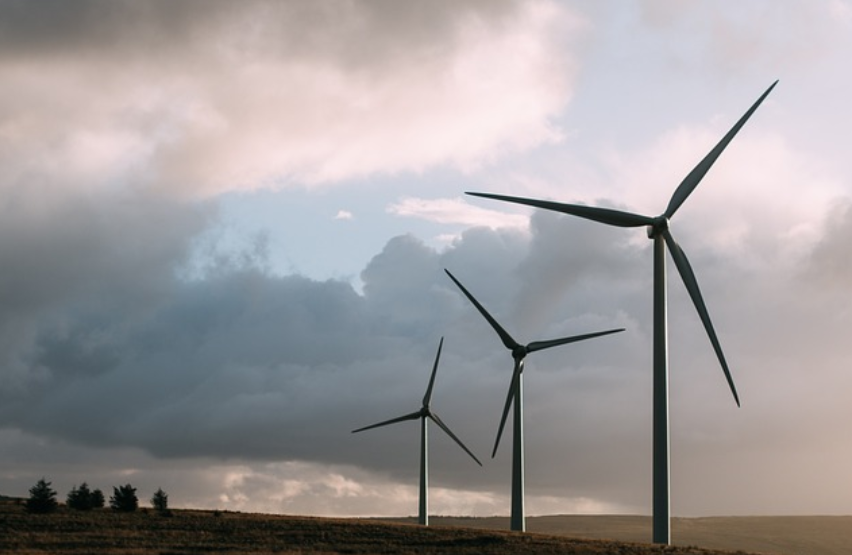 Figure 1: The majority of countries around the world are increasing their wind energy capacity as a means to reduce carbon emissions. Source: Pixabay
According to the Global Wind Energy Council (GWEC), a cumulative wind energy capacity of over 800 GW was expected globally by the end of 2021 with Europe, North America and Asia leading the market.
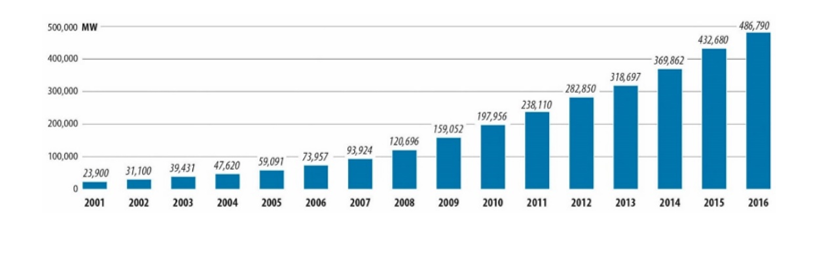 Figure 2: Global wind energy capacity from 2001 to 2016. Source: GWEC
Global wind energy capacity from 2001 to 2016
As an example of the significant growth in, for example, Asia (China), the installed wind capacity in 2010 was 44,733 MW, and in 2011 an additional 18,000 MW was added. However, Asia is only an example of the efforts made toward fostering a cleaner carbon footprint using onshore wind turbines; efforts around the world are also being made offshore.
International Swedish developer, Vattenfall, announced in 2016 that they will be building a massive 600 MW offshore wind project in the Danish Baltic Sea. The cost of the offshore wind prices for this project is in the same range as nuclear, making this project incredibly appealing and cost-effective. The overall cost of wind turbines is also decreasing with Vestas turbines at $941/kW in 2016, which is 8% lower than in 2015.
In countries that already have a large portion of their energy requirements fulfilled by renewable energy, such as in New Zealand, the wind energy market is still on the rise. New Zealand is supplied with 75% of its electricity from renewable energy sources, 5% coming from wind energy. New Zealand’s goal is to increase its reliance on renewable energy up to 90% by 2025, with wind energy contributing 20%.
Despite the huge uptake of wind energy in some countries, others with a high dependence on coal-fired electricity generation, such as South Africa, are falling behind. Close to 95% of South Africa’s electricity production comes from non-renewable sources, making it a costly exercise to implement the infrastructure for wind energy.
Current and future wind energy technology trends
It has already been established that wind energy is on the rise, but there are currently opportunities, challenges and technological advancements in wind energy that need to be addressed. Wind turbines can be classified in a multitude of ways depending on their application. It can be a vertical or horizontal axis wind turbine, the most common for large-scale wind farms being the horizontal axis wind turbine. The speed of the wind turbine can be fixed or variable, geared or direct drive, and synchronous or asynchronous. Figure 3 below shows a comparison of three wind turbine models that vary in size and power.
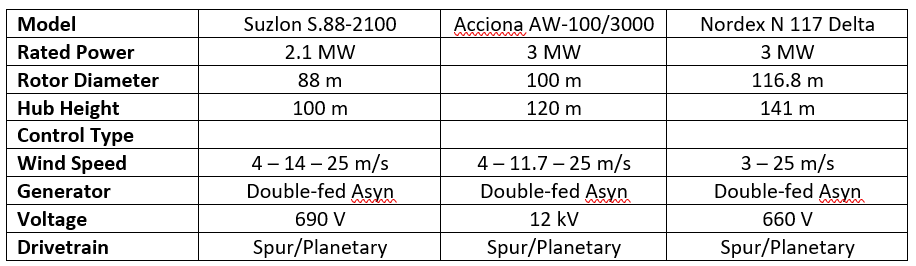 Figure 3: A comparison of three wind turbine models that vary in size and power. Source: GWEC
The generator and drivetrain types are the same for all three wind turbines since these are common specifications for high-powered wind turbines. The hub heights and rotor diameters increase in size, but just how much bigger can these get? Thus far, the largest turbine ever made is the MHI Vestas V164 offshore turbine, which is rated at 9.5 MW. Building a larger turbine brings about sturdiness problems and would require finding a material that would be able to withstand the large tower heights and the diameter of the blades. Figure 4 below shows the size trend of wind turbines. The future opportunities for wind turbines present an array of possibilities with future wind turbines reaching up to 20 MW with rotor diameters of 250 m.
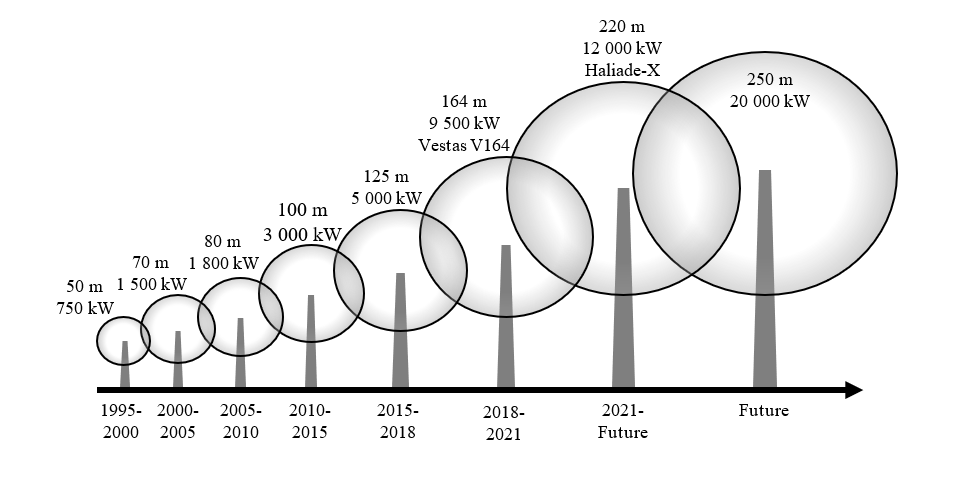 Figure 4: Size trend of wind turbines. Source: GWEC
Wind energy innovations
Other technological advancements are currently taking place, which has allowed for the cost of wind turbines to decrease. As stated previously, future wind turbines would need to withstand increased stresses. Research and development (R&D) centers are focusing on stronger fiberglass composites and curved blade designs. Curving the tip of a blade would allow for a more effective wind turbine at lower wind speeds, thereby, increasing the efficiency of the turbine.
Another option is to decrease the overall weight of wind turbines by converting larger turbines to direct drive or a hydraulic drivetrain, allowing for heavy gearboxes to be removed. Lastly, remote electronic controls along with a turbine having pitch and variable speed control capabilities will allow for the remote capturing of real-time data. Turbine-mounted devices such as lidar (light detection and ranging) and sodar (sonic detection and ranging) would be used.
Besides the advancement in horizontal axis turbines, various companies aim to redesign the wind turbine. For example, Vortex Bladeless has created a wind turbine that does not have any rotor blades. Wind energy is captured through vorticity, causing the device to oscillate. The oscillations move a linear generator that converts the kinetic energy of the oscillations into electricity. However, some criticize the authenticity of the design and whether it will reach market production.
Kite-type turbines are also being built such as a circling kite by Google subsidiary Makani. The 600 kW wing-mounted turbines can reach a height of 300 m and produce electricity as it swings in large circles in the sky. Other turbine redesigns include hummingbird-type blade designs and helium-filled airborne turbines.
GE Renewables has thought of combining hydropower with wind turbines in Germany. The turbines will be located on a hill where the wind resource is good, and the base of the turbine will be able to hold 34 million liters of water. When the wind is not blowing, the water is released downhill to a turbine to generate hydroelectricity and pumped back up when the wind turbine starts generating electricity again. The hydro-wind configuration will allow for continual electricity production.
Wind energy on the rise
The cost of wind turbines will continue to plummet as technology advances and new designs are brought to the market. Wind energy and solar photovoltaic technology are head-to-head in terms of cost and innovation. Both technologies come with their benefits, but wind energy takes the lead when it comes to land occupation and electricity generation. By looking at the amount of wind energy capacity that has been implemented in just a few short years, there is potential for a huge wind energy boom as prices become even more cost-competitive with non-renewable energy production.