Video: Photocatalyst lights up ammonia-to-hydrogen conversion
S. Himmelstein | December 29, 2022The potential contribution of ammonia to global decarbonization goals improves with the development of an inexpensive scalable catalyst that uses light instead of heat to convert ammonia into hydrogen fuel.
This ammonia-splitting photocatalyst uses iron as its reactor, and copper as its light-collecting antenna — both cheap and abundant metals, as opposed to the typical copper-ruthenium thermal catalysts currently in use. Under laser light illumination during laboratory tests, the copper-iron plasmonic, or light-activated, catalyst showed efficiencies and reactivities that were comparable with those of copper-ruthenium. Additional trials using a commercially available, LED-powered reactor showed the catalysts retained their efficiency under LED illumination and at a scale 500 times larger than the lab setup.
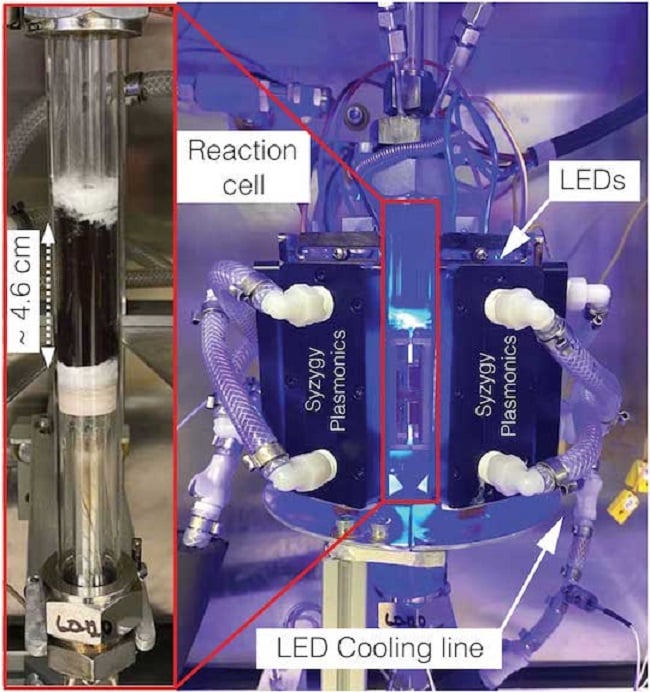 A reaction cell (left) and the photocatalytic platform (right) used on tests of copper-iron plasmonic photocatalysts for hydrogen production from ammonia. All reaction energy for the catalysis came from LEDs that produced light with a wavelength of 470 nm. Source: Syzygy Plasmonics Inc.
The low-cost photocatalytic technology detailed in Science broadens scope for production of sustainable hydrogen at local scales rather than in massive, centralized plants. The elimination of elevated heat treatment requirements also promises to reduce greenhouse gas emissions and fuel consumption during the ammonia-to-hydrogen conversion process.
Researchers from Houston, Texas-based Syzygy Plasmonics Inc., Rice University, University of California Los Angeles and Princeton University contributed to this development.