Video Pill Uses Fluorescent Light for Better Imaging
Engineering360 News Desk | December 24, 2015Researchers from the University of Glasgow have found a way to make swallowable cameras more effective at detecting cancers of the throat and gut.
In recent years, sensing systems small enough for patients to swallow have proven to be a valuable clinical alternative to more intrusive imaging methods such as endoscopes. Until now, the systems, often known as video pills, have relied on illuminating patients’ innards using a light source, restricting clinicians to conclusions based on what they can see in the spectrum of visible light.
Researchers, led by David Cumming, professor of electronic and nanoscale engineering at the University of Glasgow, have demonstrated the use of an advanced semiconductor single-pixel imaging technique to create fluorescence imaging and expand the diagnostic capabilities of the video pill.
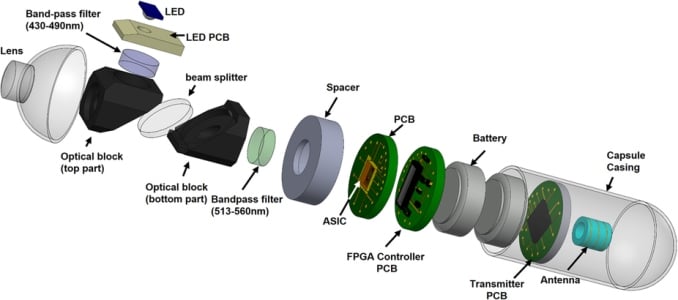 3D view of the wireless fluorescence capsule endoscope. Image credit: University of Glasgow.“We’ve confirmed in the lab the ability of the system to image fluorescence ‘phantoms’—mixtures of flavins and hemoglobins that mimic closely how cancers are affected by fluorescence in parts of the body like the intestines, the bowel and the esophagus," research associate Dr. Mohammed Al-Rawhani says.
Fluorescence imaging is already a powerful diagnostic tool in medicine, capable of identifying in patients the blood supplies that support cancers and help them grow, but which can be missed by examination under visible light. However, past fluorescence imaging technologies have been expensive and bulky and consume substantial power, confining the technique to laboratories and hospital examination rooms.
According to the researchers, their system is small enough and power-efficient enough to image the entire human gastrointestinal tract for up to 14 hours.
The video pill could also be used to help track antibodies used to label cancer in the human body, creating a new way to detect cancer, says Al-Rawhani. “It’s a valuable new technique that could help clinicians make fewer false positives and negatives in cancer diagnosis, which could lead to more effective treatment in the future,” he says.
The team is now in early talks with industry to bring a product to market.
"We’re also interested in expanding the imaging capabilities of video-pill systems to new areas such as ultrasound in the near future,” says Cumming.