Sensor Detects Toxins That Leach from Plastic
Engineering360 News Desk | December 16, 2015Engineers from Massey University have developed a device that is able to detect synthetic compounds that leach from plastic packaging into food and beverages.
Such compounds are a health concern as they have been linked to genetic, developmental and fertility defects in humans.
The device, conceived by Dr. Asif Zia and Professor Subhas Mukhopadhyay, both from the School of Engineering and Advanced Technology, is an electrochemical sensing system able to rapidly quantify a synthetic compound, di(2-ethylhexyl)phthalate (DEHP).
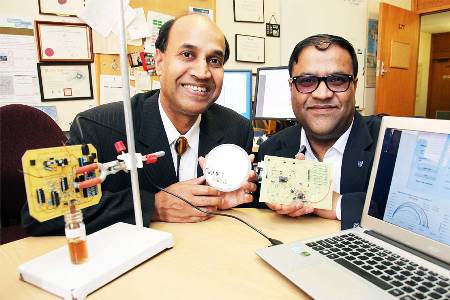 Professor Subhas Mukhopadhyay (l) and Dr. Asif Zia (r) have developed an electrochemical sensing system to quantify leached DEHP. Image credit: Massey University.DEHP is used to induce flexibility in the plastic products but, because of its molecular structure, it does not attach itself covalently to the plastic’s lattice structure. As a result, it may leach into the environment. It is classed as a teratogenic, or malformation-causing, compound as well as an endocrine disrupter, which can interfere with the body’s natural hormonal system. The World Health Organization considers concentrations of DEHP greater than six parts per billion as hazardous for human health.
The 2.5mm-by-2.5mm sensor is able to be swirled through a liquid and detect concentration levels as low as two parts per billion, using a test that takes less than 10 minutes. The sensor is coated with a molecular imprinted polymer, essentially a type of chemical Velcro that selectively catches only DEHP molecules in liquids. The molecules “stick” by forming weak hydrogen bonds with the coating. After the sensor is rinsed, electromagnetic fields are passed through it (spectroscopy) to determine the concentration of DEHP present.
According to Zia, the technology is fast, simple to use, sensitive enough to detect small amounts of the compound and robust, as the coating offers a shelf life of years without degrading and can be regenerated and reused.
“Previous technology required taking a sample to the lab, where they would first have to separate the molecule in question and then test it via flame ionization detection, mass spectroscopy and high performance liquid chromatography. This could take up to a week," Zia says. "Using electrochemical impedance spectroscopy, the test procedures take only a few minutes.”
The researchers' hope is that the sensor can be integrated into a tap in a “smart home”—fitted throughout with sensing equipment and computational power—to offer the occupant on-demand information.
Some countries, including the United States, have banned DEHP's use in plastics. But for residents in countries that have not banned them, the device may provide a way to ensure there aren’t harmful levels of contamination in packaged food and drinks.
“Plastic is a way of life, it’s hard to get around that. Every day we could be ingesting tiny amounts of these compounds that, over time, can build up in the body and cause problems," Zia says.